
Medically reviewed by the emergency care team at Aether Health – Spring Cypress ER, a freestanding 24/7 emergency room in Spring, TX
| Why this matters. A blood clot in the leg (deep vein thrombosis, or DVT) can break loose and travel to the lungs, causing a life-threatening pulmonary embolism. One leg suddenly swelling, warm, and sore is reason to come in the same day. Aether Health – Spring Cypress ER is open 24 hours a day at 8929 Spring Cypress Rd. Call (713) 528-8703. |
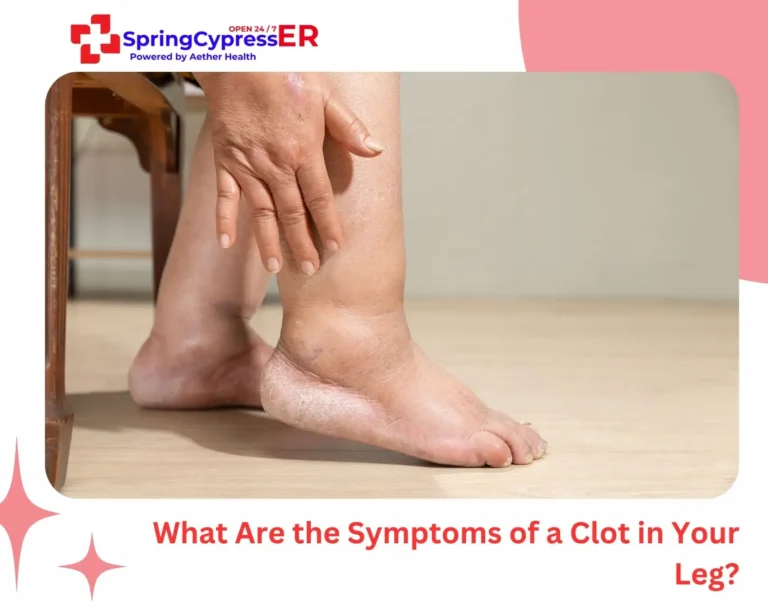
What are the symptoms of a clot in your leg? The classic signs are swelling on one side only, warmth to the touch, redness or a reddish-purple discoloration, and a deep, cramping pain in the calf or thigh. At Aether Health – Spring Cypress ER, our board-certified physicians evaluate suspected deep vein thrombosis (DVT) with same-visit Doppler ultrasound and lab testing. Spotting the signs early matters, because a leg clot can break loose and reach the lungs within hours.
What are the symptoms of a clot in your leg?
The symptoms of a clot in your leg include one-sided swelling, deep aching pain, warmth, red or discolored skin, and tenderness when pressing the calf. According to the American Heart Association guide to venous thromboembolism, half of all DVT cases produce no obvious symptoms at all, which is why risk-factor awareness is almost as important as the symptoms themselves.¹
The giveaway sign is one-sidedness. Both legs feeling sore after a run is normal. One leg suddenly swelling, hot, and painful without a clear injury is not. If a leg looks noticeably different from the other, treat it as a possible DVT until a doctor confirms otherwise.
Where leg clots form and how each location feels
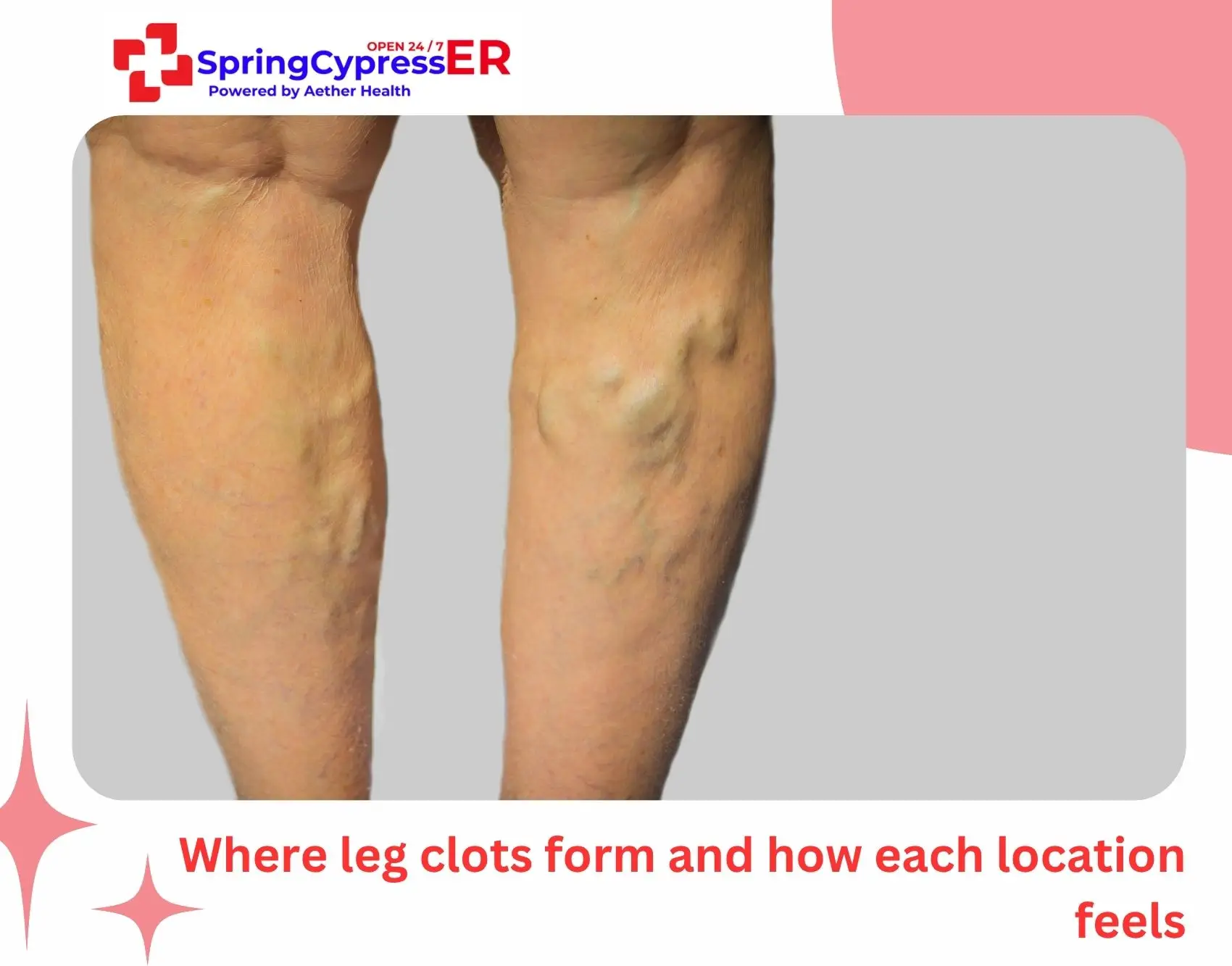
DVT does not always strike in the same spot. The location of the pain tells you something about how serious the clot may be and how urgently to come in.
| Leg Region | Where You Feel It | What It Signals |
|---|---|---|
| Calf (lower leg) | Behind the knee down to the ankle, often one-sided | Most common DVT site. Cramping or Charley-horse-like pain |
| Thigh (upper leg) | Inner thigh or groin area, dull aching pain | Higher-risk DVT. More likely to break loose and travel |
| Behind the knee | Tight pressure, pain when flexing the foot | Classic Homans sign location, deserves evaluation |
| Whole leg | Entire leg swollen, discolored, hot to touch | Major DVT (iliofemoral). This is an emergency |
The 4 levels of DVT pain and when each needs the ER
Not every leg ache is a DVT, and not every DVT feels severe. Use this intensity scale to match your symptoms to the right level of urgency. Keep in mind that pain level alone is not enough. A mild ache with risk factors still warrants evaluation.
| 1 | Mild | Vague ache or tightness, barely noticeable. Still worth monitoring if risk factors are present. |
| 2 | Moderate | Steady soreness that worsens when walking, climbing stairs, or standing. Visit the ER same day. |
| 3 | Severe | Sharp, constant pain. Leg feels swollen, warm, and tender. Call for a ride and come in now. |
| 4 | Emergency | Sudden shortness of breath with leg pain. The clot may have moved to the lungs. Call 911 immediately. |
Who is most at risk for a leg clot
| Related reading: What is the treatment for a blood clot in the brain?. A companion guide for understanding how clots travel and what care looks like. |
Per the NHLBI deep vein thrombosis overview, roughly 350,000 to 600,000 Americans develop DVT each year. Risk rises sharply after surgery, during long immobility, and with certain medical conditions. The following groups face the highest risk.²
- Recent surgery or hospitalization: Especially orthopedic (hip, knee), cancer, or abdominal surgery. Immobility is the main driver.
- Long-distance travel: Flights or car rides over 4 hours without leg movement raise risk, more so for people over 60.
- Pregnancy and postpartum: The first 6 weeks after delivery carry the highest DVT risk of pregnancy.
- Hormonal factors: Birth control pills, hormone replacement therapy, and some cancer treatments increase clotting.
- Prior DVT or PE: A past clot roughly triples your lifetime risk of a new one.
- Cancer and chemotherapy: Some cancers and treatments drive hypercoagulability.
- Obesity, age over 60, and smoking: Each is an independent risk factor that stacks with others.
When symptoms of a clot in your leg need the ER
DVT is one of the fastest-moving diagnoses in emergency medicine. The right first action depends on what you are seeing.
- CALL 911 if leg symptoms are joined by sudden shortness of breath, sharp chest pain, or fainting. The clot may have reached the lungs. Our emergency blood clot treatment program is prepared for this exact pathway.
- Walk in same day: If one leg is suddenly swollen, warm, red, or painful without an injury, come in. Do not wait to see if it improves overnight.
- Phone us first: If you have significant risk factors but mild symptoms, call ahead and we will guide you on timing.
- Do NOT massage the leg: Rubbing or pressing a suspected clot can dislodge it. Keep the leg still and raised if possible.
- Do NOT apply heat: Heat does not treat a clot and can worsen inflammation. Save temperature management for after diagnosis.
How a freestanding ER confirms or rules out DVT
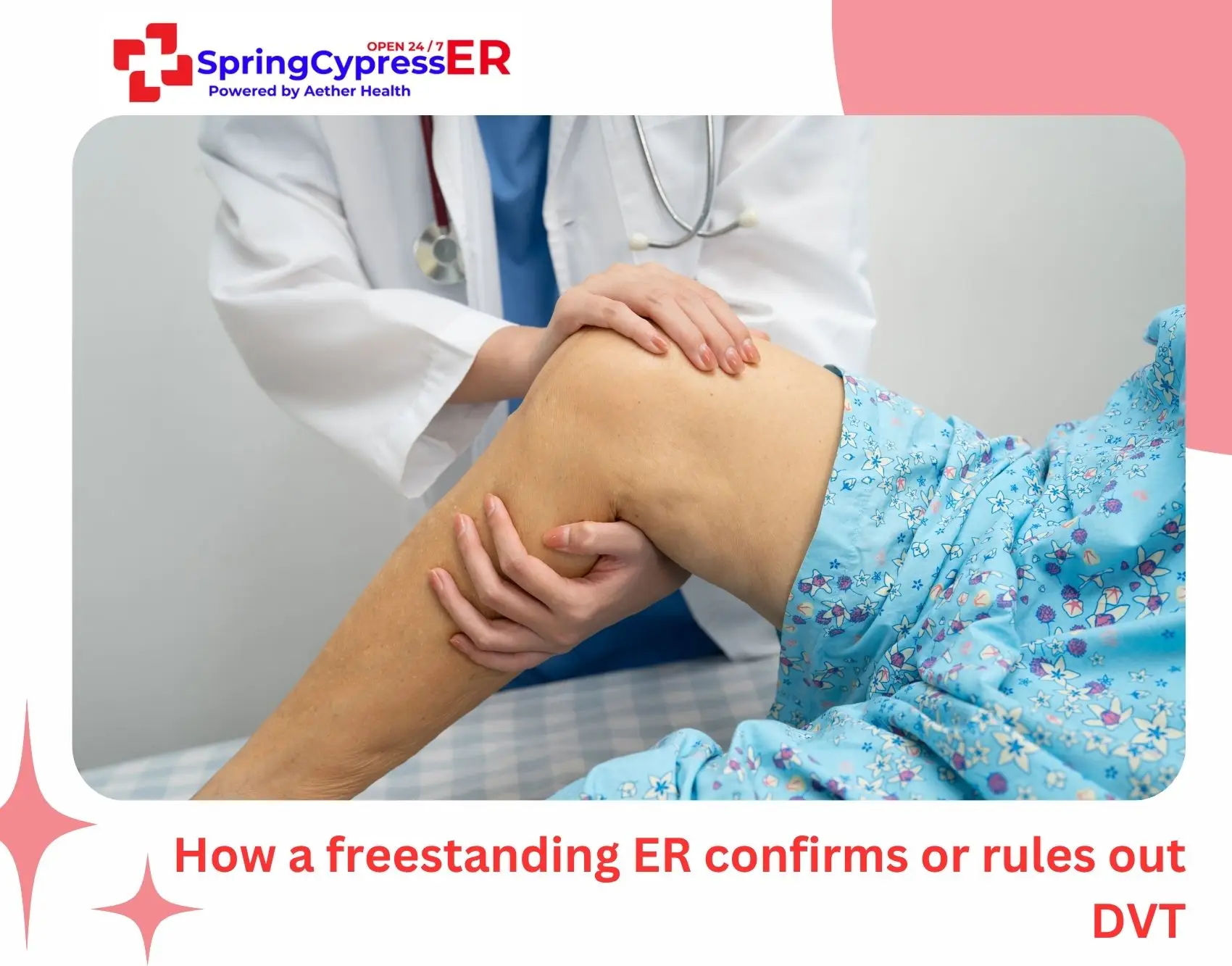
Suspected DVT needs quick, decisive testing. Our on-site capabilities compress the usual multi-hour workup into one visit, which matters when a clot could be enlarging.
| Test | What It Tells Us |
|---|---|
| D-dimer blood test | Screens for active clotting in the body. Fast negative result rules out DVT in many patients |
| Doppler ultrasound | The gold standard for DVT. Shows blood flow and clot location in minutes, no radiation |
| Physical exam + Wells score | Combines symptoms, risk factors, and clinical signs to estimate DVT probability |
| CT venogram (rare) | For suspected large pelvic or iliac vein clots when ultrasound is inconclusive |
The freestanding ER model keeps door-to-ultrasound time short. In a hospital emergency department, D-dimer plus Doppler can stretch across half a day. Here it is usually complete within 60 to 90 minutes, often sooner. When DVT is confirmed, we start treatment, coordinate inpatient care if needed, and arrange follow-up.
Questions before you come in? Message our care team any time. We respond 24/7.
Common questions
Q1. Can you have a leg clot without pain?
Yes. Half of all DVT cases are silent at first. Painless swelling of one leg, especially with risk factors, is enough to seek evaluation. Do not wait for severe pain to appear.
Q2. How quickly do the symptoms of a clot in your leg appear?
Symptoms usually develop over hours to a few days. Rapid onset is more common after surgery or long immobility. Any sudden one-sided leg change in a high-risk person deserves same-day evaluation.
Q3. What does a leg clot feel like compared to a pulled muscle?
A pulled muscle hurts with movement and eases with rest. A DVT often aches constantly, feels warm, and may make the calf measurably larger. Pulled muscles do not usually cause one-sided swelling.
Q4. Can a DVT resolve on its own?
Small clots sometimes dissolve on their own, but the risk of complications is too high to rely on this. Untreated DVT can lead to pulmonary embolism or long-term post-thrombotic syndrome in the leg.
Q5. Do leg clots happen in young or healthy people?
Yes. Long flights, oral contraceptives, pregnancy, dehydration, and family history can trigger DVT in young, otherwise healthy adults. Age is only one of many risk factors.
Suspected DVT in Spring, TX? Walk in now
A one-sided swollen leg with warmth and pain is a time-critical sign. Do not wait for it to pass. Walk in to our freestanding ER for same-visit evaluation.
Aether Health – Spring Cypress ER | Freestanding 24/7 Emergency Room
8929 Spring Cypress Rd, Spring, TX 77379 | (713) 528-8703
No appointment. No referral. Walk in any time.