Medically reviewed by the emergency care team at Aether Health – Spring Cypress ER, a freestanding 24/7 emergency room in Spring, TX
| This is a medical emergency.
A pulmonary embolism can be fatal within hours. If you or someone near you has sudden shortness of breath, sharp chest pain, coughing up blood, or sudden collapse, call 911 immediately or come to Aether Health – Spring Cypress ER for emergency blood clot treatment. 8929 Spring Cypress Rd. Open 24/7. Call (713) 528-8703. |
What does a pulmonary embolism feel like? Most people describe it as a sudden struggle to breathe paired with sharp chest pain that stabs with each inhale. A pulmonary embolism (PE) happens when a blood clot blocks an artery in the lung, cutting off blood flow. The symptoms arrive fast, often without warning. Recognizing the feeling early is the single most important thing you can do, because PE can be fatal within hours if left untreated.
What does a pulmonary embolism feel like?
A pulmonary embolism typically feels like a sudden inability to catch your breath along with sharp, stabbing chest pain that gets worse when you inhale. According to the NHLBI guide to pulmonary embolism, most patients also notice a racing heart, cough, and lightheadedness within minutes of onset.²
The combination matters more than any single symptom. Shortness of breath alone could be asthma. Chest pain alone could be a muscle strain. But all three arriving together, especially in someone with risk factors, points strongly toward PE until proven otherwise.
The 6 core sensations of a pulmonary embolism
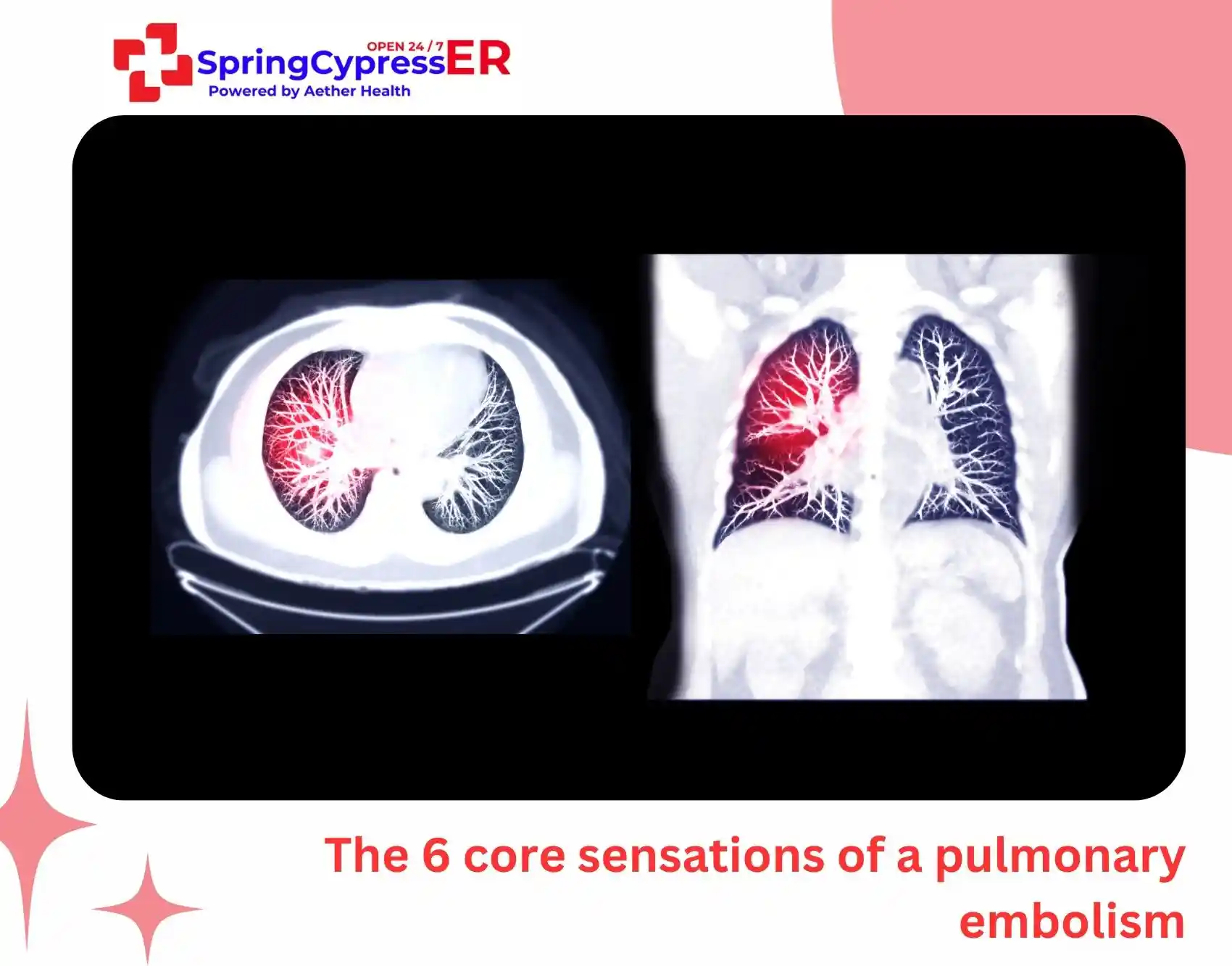
Here are the six sensations most frequently reported by PE survivors. Any three of them appearing together within minutes to hours is a medical emergency.
| [1] Shortness of breath
A sudden feeling that air cannot reach your lungs. Comes on without exertion. Does not improve with slow breathing or rest. |
[2] Sharp chest pain
A stabbing pain that worsens with each breath (pleuritic). Often felt on one side. May spread to the shoulder or upper back. |
| [3] Rapid heartbeat
A racing or pounding heart (over 100 bpm at rest). May feel like you just climbed stairs when you have been still. |
[4] Lightheadedness
Dizziness, near-fainting, or a feeling that the room is spinning when you stand or try to move. |
| [5] Coughing up blood
Pink-tinged mucus or small amounts of actual blood when coughing. This is a red-flag sign requiring 911. |
[6] A sense of dread
Many PE patients describe an overwhelming feeling that something is wrong. Trust this. Do not ignore it. |
How pulmonary embolism pain differs from a heart attack or pneumonia
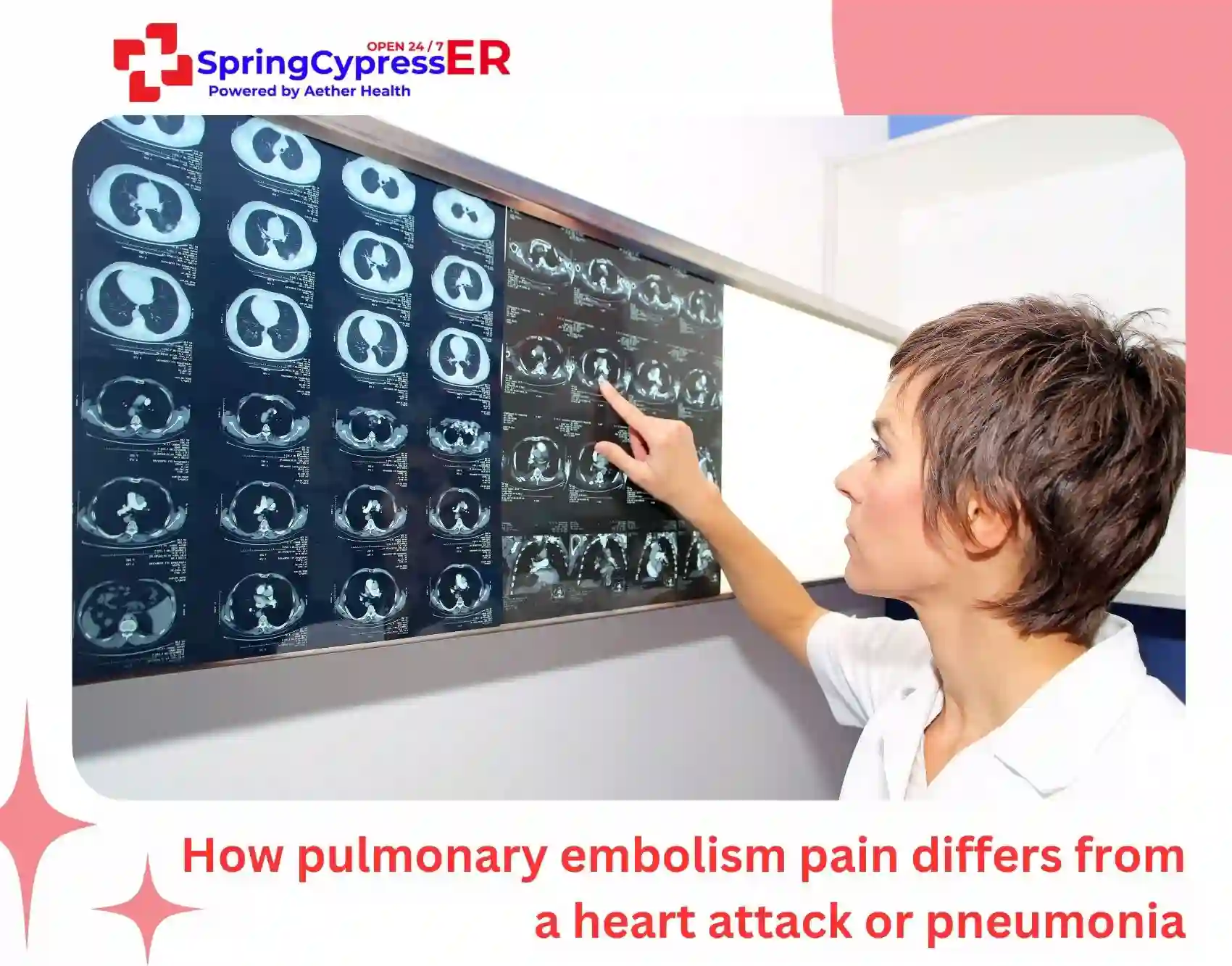
Chest pain has many causes. Knowing how PE pain differs can speed the right diagnosis in the ER. PE pain is sharp and stabbing rather than crushing. It worsens with each breath (pleuritic). It is often one-sided. And it does NOT ease with rest the way angina does.
Pulmonary embolism also behaves differently from a heart attack. Where a heart attack causes crushing pressure that may radiate to the jaw and left arm, PE causes a knife-like, breath-dependent pain that stays near the ribs. The clot itself typically starts in a leg vein. The companion guide on how a blood clot can travel even after treatment explains how a leg clot migrates into the lungs and why follow-up matters.
- Heart attack pain: Crushing pressure, radiates to arm/jaw, worse with exertion, lasts minutes to hours.
- Pneumonia chest pain: Dull ache with productive cough, high fever, builds over days.
- Pulmonary embolism pain: Sharp, stabbing, breath-dependent, sudden onset, often one-sided, with shortness of breath.
Risk factors ranked by tier
Not everyone has the same PE risk. These three tiers show how doctors stratify risk when symptoms are ambiguous. If you fit Tier 1 and have any symptom from the card grid above, treat it as an emergency.
| TIER 1
HIGHEST |
• Recent surgery, especially orthopedic or pelvic
• Prior DVT or pulmonary embolism • Active cancer or recent chemotherapy • Immobility: hospitalization, cast, or bed rest over 3 days |
| TIER 2
HIGH |
• Long-distance travel (over 4 hours by plane or car)
• Pregnancy or postpartum (first 6 weeks) • Birth control pills or hormone replacement therapy • Obesity (BMI over 30) |
| TIER 3
MODERATE |
• Age over 60
• Smoking • Family history of blood clots • Varicose veins or chronic venous insufficiency |
Per CDC data on venous thromboembolism, up to 900,000 Americans are affected by blood clots each year, and PE is the third leading cause of cardiovascular death after heart attack and stroke. The condition is far more common than most people realize.¹
When PE symptoms are a 911 emergency
Pulmonary embolism is time-critical. The split flag chart below separates red-flag symptoms that need 911 from yellow-flag symptoms that still need same-day emergency evaluation but can safely be reached by walking in.
| RED FLAG: Call 911
• Sudden severe shortness of breath • Fainting or near-fainting • Coughing up blood • Blue lips or fingertips • Chest pain with rapid heartbeat |
YELLOW FLAG: Walk in ASAP
• Mild shortness of breath that is new • Calf swelling or pain on one side • Mild chest ache worsening with breath • Resting heart rate suddenly higher • Risk factors plus any of the above |
For yellow-flag symptoms, walk in to Aether Health – Spring Cypress ER rather than driving to a hospital emergency department. On-site CT scanning, D-dimer blood testing, and board-certified emergency physicians cut diagnostic time from hours to minutes, which matters when a clot could be enlarging.
How a freestanding ER evaluates suspected pulmonary embolism
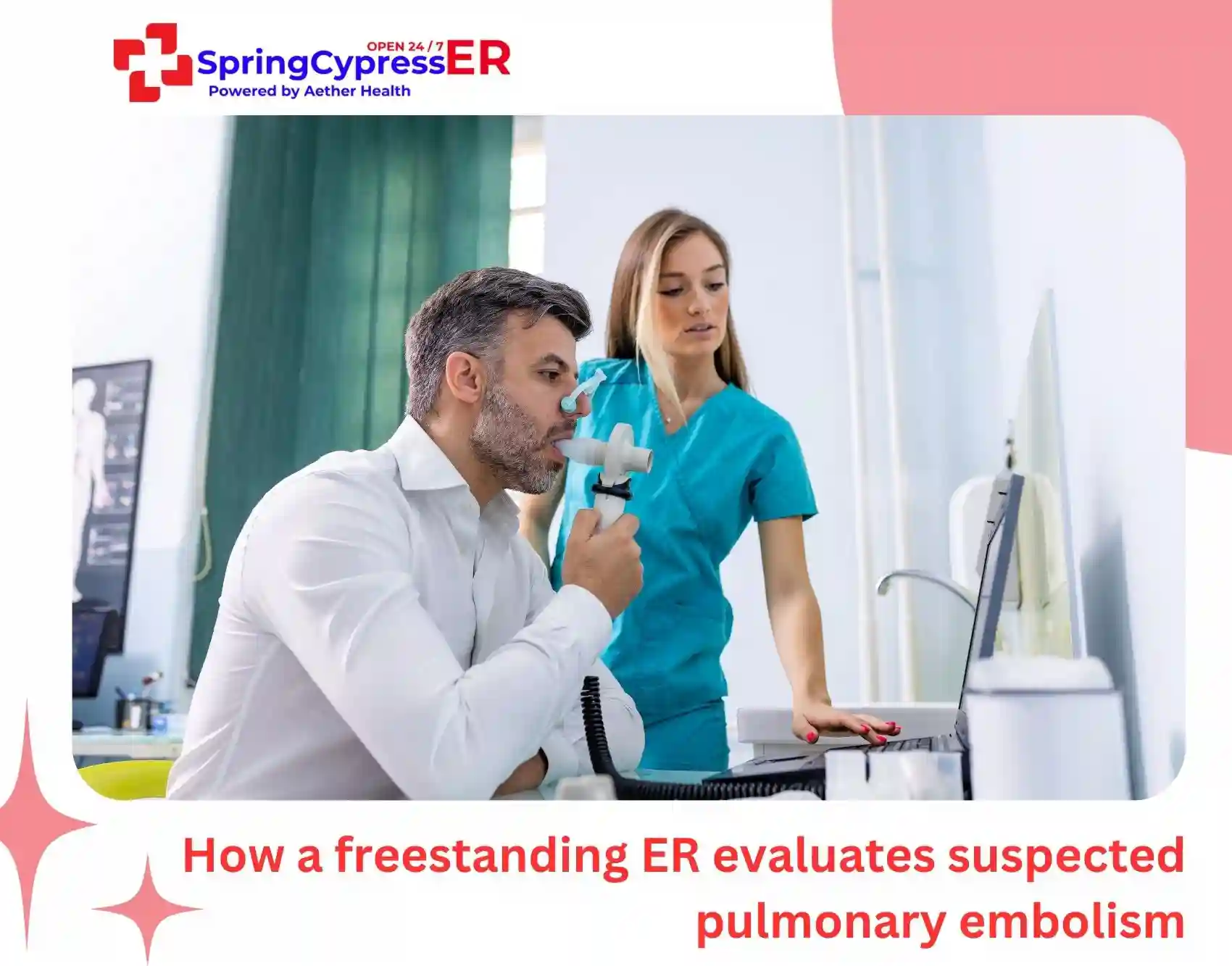
A suspected PE is one of the most time-sensitive diagnoses in emergency medicine. Here is what happens during a focused evaluation at our freestanding emergency room.
- Immediate triage: Vitals and oxygen saturation checked within minutes of arrival. Nasal oxygen started if saturation is low.
- Focused clinical exam: A board-certified emergency physician applies the Wells score or PERC rule to estimate PE probability.
- D-dimer blood test: A rapid test that screens for abnormal clotting activity. Results available in minutes at our on-site lab.
- CT pulmonary angiogram: The gold standard imaging test for PE. On-site CT means confirmation in under 60 minutes.
- EKG and chest X-ray: Rule out heart attack and pneumonia at the same visit, pairing imaging with real-time physician review.
- Coordinated transfer: For confirmed PE, we stabilize and transfer directly to a partner hospital for continued inpatient care.
The freestanding ER model matters here because every minute counts. Door-to-CT time in a crowded hospital ER can stretch past 90 minutes. Here it averages under 45, giving physicians earlier information and the patient earlier treatment.
Common questions
Q1. What does a pulmonary embolism feel like in the chest?
A sudden sharp, stabbing pain that worsens with each breath. Often felt on one side, sometimes radiating to the shoulder. Unlike a heart attack, it is not crushing or pressure-like.
Q2. Can a pulmonary embolism feel mild at first?
Yes. Small PEs can feel like mild breathlessness or a nagging cough for days before worsening. Any new shortness of breath in someone with risk factors deserves same-day evaluation.
Q3. How fast does pulmonary embolism progress?
A massive PE can be fatal within an hour of symptom onset. Smaller clots may evolve over hours or days. Either way, suspected PE needs emergency evaluation the same hour symptoms appear.
Q4. What does a pulmonary embolism feel like after flying?
Classic post-flight PE causes sudden shortness of breath, calf swelling, and pleuritic chest pain within hours to days of landing. Long flights (over 4 hours) are a recognized risk factor.
Q5. Can anxiety mimic pulmonary embolism symptoms?
Panic attacks and PE share symptoms: shortness of breath, racing heart, chest tightness, and dread. The only safe approach is emergency evaluation. A D-dimer plus CT scan tells the two apart.
Suspected pulmonary embolism in Spring, TX? Walk in now
Pulmonary embolism is one of the fastest-moving emergencies in medicine. If any red-flag symptom is present, call 911. For yellow-flag symptoms, walk directly into our freestanding ER.
Aether Health – Spring Cypress ER | Freestanding 24/7 Emergency Room
8929 Spring Cypress Rd, Spring, TX 77379 | (713) 528-8703
No appointment. No referral. Walk in any time.
| Have a question before you visit? Reach the Aether Health – Spring Cypress ER care team any time of day or night. We are a freestanding emergency room with no appointment required. |