

Medically reviewed by the emergency care team at Aether Health – Spring Cypress ER
| A quick note before you read on. This guide answers when your baby’s heart begins to beat and how doctors detect it during pregnancy. If you are experiencing heavy vaginal bleeding, severe pelvic pain, dizziness, or any sign of a pregnancy emergency, please call 911 or come to Aether Health – Spring Cypress ER right away. |
When does a baby have a heartbeat? A developing baby’s heart begins to beat around the fifth to sixth week of pregnancy, counted from the first day of your last menstrual period. That early heartbeat is too faint to hear with a stethoscope, but it can be seen as a flickering motion on transvaginal ultrasound. Over the following weeks, the heart develops from a simple pulsing tube into a four-chambered organ that a handheld Doppler can pick up at prenatal check-ups.
When does a baby have a heartbeat during pregnancy?
The short answer to when does a baby have a heartbeat is around 5 to 6 weeks of pregnancy, calculated from the first day of your last menstrual period (LMP). At this early stage, the heart is still a primitive tube of cells beginning electrical activity strong enough to be seen on ultrasound.
By week 10 to 12, most parents can hear their baby’s heartbeat during a prenatal check-up using a handheld Doppler device. By week 20, the heartbeat can even be heard with a simple fetoscope. Each stage of pregnancy uses different tools to detect the heartbeat as the tiny organ grows.
Week-by-week fetal heart development timeline
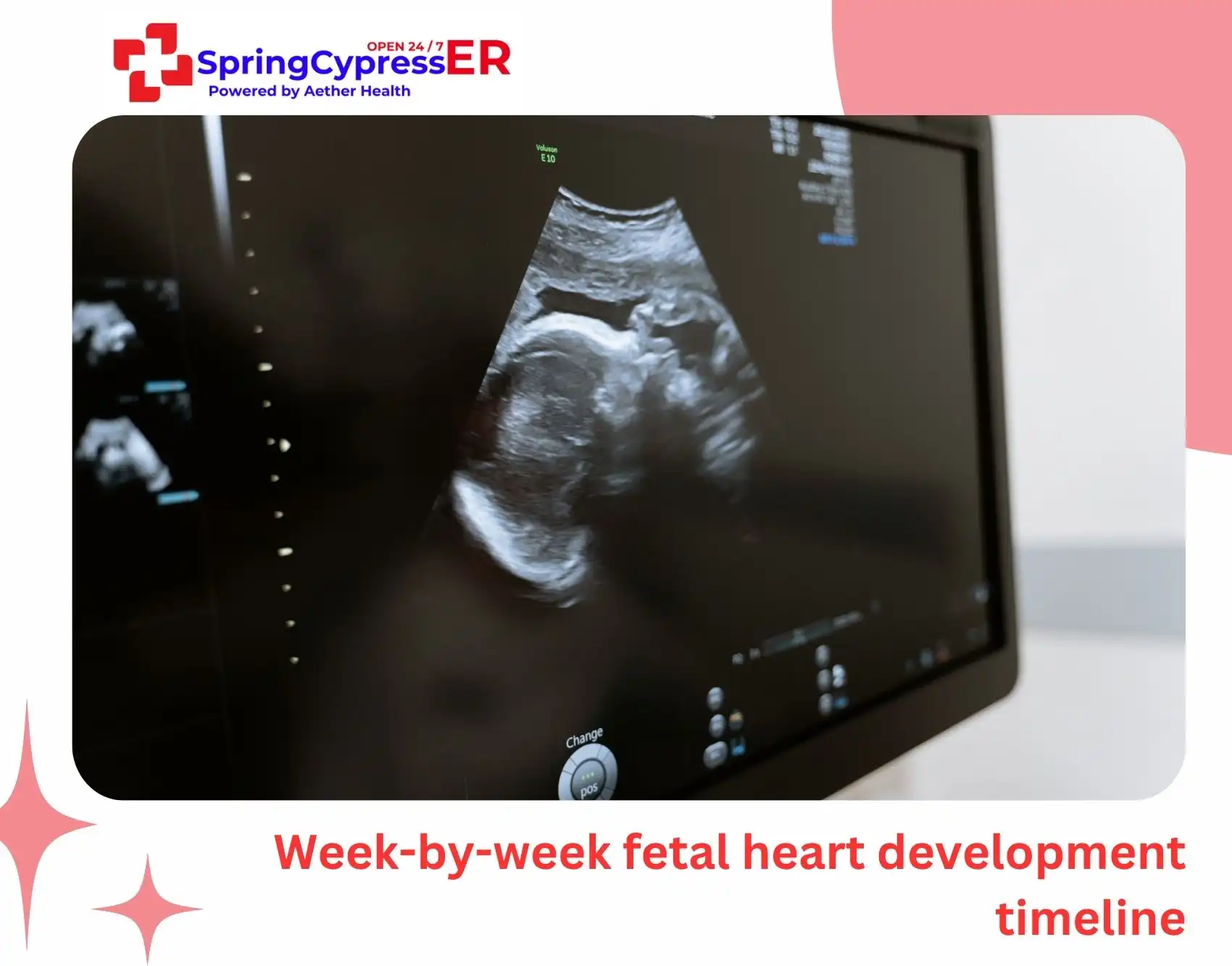
The heart is the first organ to form in a developing baby and one of the fastest to become active. According to March of Dimes pregnancy week-by-week guide, the heart starts to beat at about 105 beats per minute during the early weeks and continues to develop rapidly through the first trimester.¹
| Pregnancy Week | Heart Development Milestone |
|---|---|
| Week 3-4 | Heart cells begin to form; the tube-like structure that will become the heart appears |
| Week 5-6 | The heart begins to beat; a flickering motion is visible on transvaginal ultrasound |
| Week 7-8 | Heart begins dividing into four chambers; heart rate rises quickly |
| Week 9-10 | Heart is essentially formed and pumping; visible on standard transabdominal ultrasound |
| Week 10-12 | Heartbeat becomes detectable with a handheld Doppler at prenatal check-ups |
| Week 18-22 | The anatomy scan checks heart structure in detail; a fetal echocardiogram may be ordered if needed |
| Week 20+ | Heartbeat can be heard with a fetoscope; some parents may feel the baby’s movements |
How doctors detect a baby’s heartbeat
Different tools work at different stages of pregnancy. What can pick up a heartbeat at 6 weeks is not the same tool used at 20 weeks. Here is what your provider is likely to use during each phase.
- Transvaginal ultrasound (weeks 5 to 8): The earliest and most sensitive method. A small probe placed in the vagina picks up cardiac motion that a belly ultrasound cannot yet see at this stage.
- Transabdominal ultrasound (weeks 8 to 12+): The standard belly ultrasound most people are familiar with. Reliably shows the heartbeat once the fetus is large enough.
- Handheld Doppler (weeks 10 to 12+): A small device pressed against the belly that lets you hear the heartbeat. Common at prenatal check-ups from the second trimester onward.
- Fetoscope (weeks 20+): A specialized stethoscope shaped to hear the fetal heart. Rarely used today but still occasionally chosen for low-tech monitoring.
- Fetal echocardiogram (weeks 18 to 24): A specialized ultrasound that examines the structure of the developing heart. Ordered when heart defects are suspected or a family history warrants a closer look.
At-home Doppler devices are widely sold but not recommended. They can create false reassurance during an actual problem, or false alarm when the heartbeat is just difficult to find. Prenatal check-ups with a trained provider are the safest way to monitor a heartbeat between scans.
What is a normal fetal heart rate?
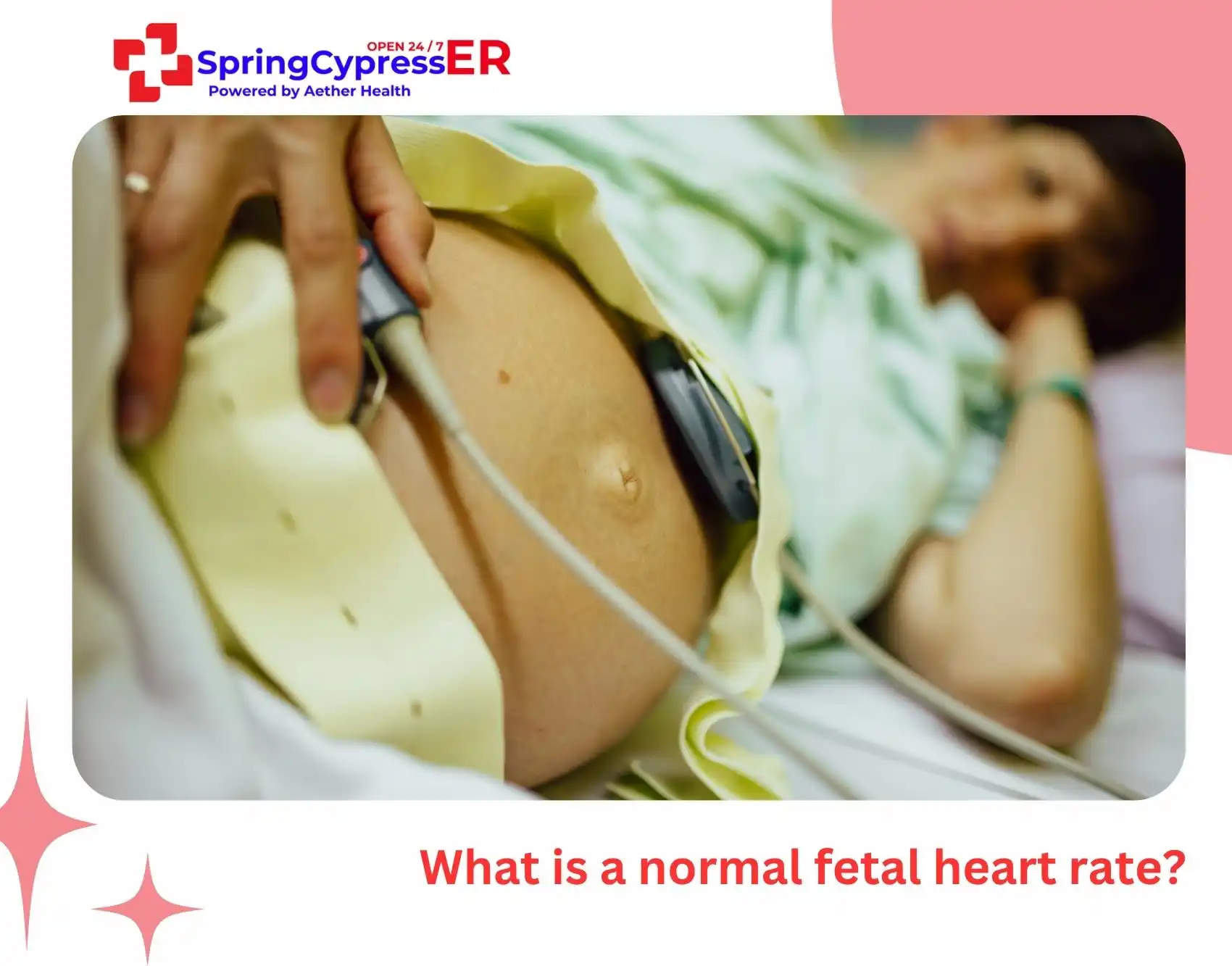
Fetal heart rate changes throughout pregnancy in a predictable pattern. It starts slow in the earliest weeks, peaks around weeks 8 to 9, then settles into a steady range for most of the second and third trimesters. The American College of Obstetricians and Gynecologists outlines these ranges as part of standard prenatal monitoring.²
| Pregnancy Stage | Typical Fetal Heart Rate (bpm) |
|---|---|
| Week 5 to 6 | 90 to 110 |
| Week 6 to 7 | 100 to 120 |
| Week 8 to 9 (peak) | 150 to 170 |
| Week 10 to 12 | 140 to 170 |
| Second and third trimesters | 110 to 160 |
Heart rate outside these general ranges may be normal for your specific pregnancy or may prompt further evaluation. Your provider will interpret the reading in context with your gestational age and overall pregnancy health.
What if no heartbeat is detected yet?
Not detecting a heartbeat at an early ultrasound is not always cause for concern. Several completely benign explanations exist, and providers usually recommend a follow-up scan in 7 to 14 days to see how things progress.
- Dating may be off. Ovulation and implantation timing can shift your actual gestational age by 1 to 2 weeks. What you thought was week 7 may really be week 5.
- Uterine position matters. A tilted uterus or one that sits deep in the pelvis can make early scans harder to interpret.
- Transvaginal versus transabdominal. Early pregnancy scans done through the belly may miss what a transvaginal probe would find.
- Very early stage. Before 6 weeks, even ideal conditions may not yield a visible heartbeat on ultrasound.
That said, a persistently absent heartbeat after 8 weeks of confirmed pregnancy, especially when combined with vaginal bleeding or cramping, may indicate a missed miscarriage. Your provider will guide next steps and offer emotional support.
Pregnancy signs that need emergency care
While most pregnancies progress without complications, some symptoms need same-day emergency evaluation. Persistent pelvic pain during pregnancy or sudden sharp pain in the lower abdomen can point to serious conditions like ectopic pregnancy or miscarriage.
Come to the ER right away, or call 911, for any of the following during pregnancy:
- Heavy vaginal bleeding or passing large clots
- Severe abdominal or pelvic pain, especially on one side
- Dizziness, fainting, or feeling like you might pass out
- Shoulder tip pain along with abdominal pain (can signal ectopic pregnancy)
- Sudden severe headache with vision changes
- Persistent vomiting that prevents keeping fluids down
- Fever above 101°F during pregnancy
- Any injury to the abdomen
| When in doubt, come in. Pregnancy emergencies move fast. Aether Health – Spring Cypress ER offers 24-hour walk-in evaluation with on-site pelvic ultrasound, lab work, and coordination with OB specialists when hospital care is needed. Call (713) 528-8703 or come to 8929 Spring Cypress Rd. |
Common questions
Can you hear a baby’s heartbeat at 8 weeks? You can see it on ultrasound at 8 weeks, but usually cannot hear it with a Doppler that early. Handheld Doppler devices typically pick up a heartbeat starting around 10 to 12 weeks of pregnancy.
What is the earliest a baby can have a heartbeat? The earliest confirmed cardiac activity appears around 5 to 6 weeks of pregnancy from the last menstrual period. Before this, the tube of cells that will become the heart is still forming and has not yet started rhythmic activity.
Is 90 bpm too slow for a fetal heartbeat? At 5 to 6 weeks, 90 bpm is within the normal range because the heart rate is still ramping up. If you are later in pregnancy, 90 bpm is below typical range and warrants evaluation. Context matters more than the number alone.
Why did the ultrasound not show a heartbeat at my visit? Several benign explanations are possible: dating may be off, the pregnancy may be earlier than expected, or a transvaginal scan may be needed instead of a belly scan. Your provider will usually rescan in 7 to 14 days to reassess.
Can I use an at-home Doppler safely? At-home fetal Dopplers are not recommended by most providers. They can create false reassurance when a real problem exists or unnecessary panic when the heartbeat is just hard to find. Prenatal check-ups remain the safest option.
Pregnancy emergency care in Spring, TX
Pregnancy questions about developmental milestones like the heartbeat are best answered by your OB provider. For pregnancy emergencies, Aether Health – Spring Cypress ER is open 24 hours a day, 7 days a week for walk-in evaluation. Board-certified emergency physicians, on-site pelvic ultrasound and lab work, and direct coordination with OB specialists when hospital care is needed.
Aether Health – Spring Cypress ER | Open 24/7
8929 Spring Cypress Rd, Spring, TX 77379 | (713) 528-8703
No appointment. Walk in any time.
External References Links :