Medically reviewed by the emergency care team at Aether Health – Spring Cypress ER, a freestanding 24/7 emergency room in Spring, TX
| The short answer. Yes, many irregular heart rhythms return to normal, often on their own or with treatment. The path depends on the cause: lifestyle-driven palpitations usually resolve within hours to days, while structural arrhythmias may need procedures or medication. This guide maps every category to its realistic outlook. |
Can an irregular heart beat return to normal, or is it a lifelong condition once it starts? For most people, the answer is yes. An irregular heart beat can return to normal when the underlying trigger is identified and addressed, whether that trigger is caffeine, stress, dehydration, a thyroid shift, or a specific type of arrhythmia. Some rhythms correct themselves within hours. Others need a procedure or medication to reset. The right answer for you depends on which type you have.
Can an irregular heart beat return to normal?
Yes. Many irregular heart beats return to normal on their own or with treatment. According to the American Heart Association guide to atrial fibrillation, even persistent arrhythmias like AFib can be converted back to normal rhythm with medication, cardioversion, or ablation in a large share of patients.¹
The key variable is cause. Lifestyle-related palpitations resolve quickly once the trigger stops. Structural arrhythmias from scar tissue, heart disease, or valve problems need medical treatment. Diagnostic evaluation is the fastest way to find out which category you fall into.
The path from irregular to normal rhythm
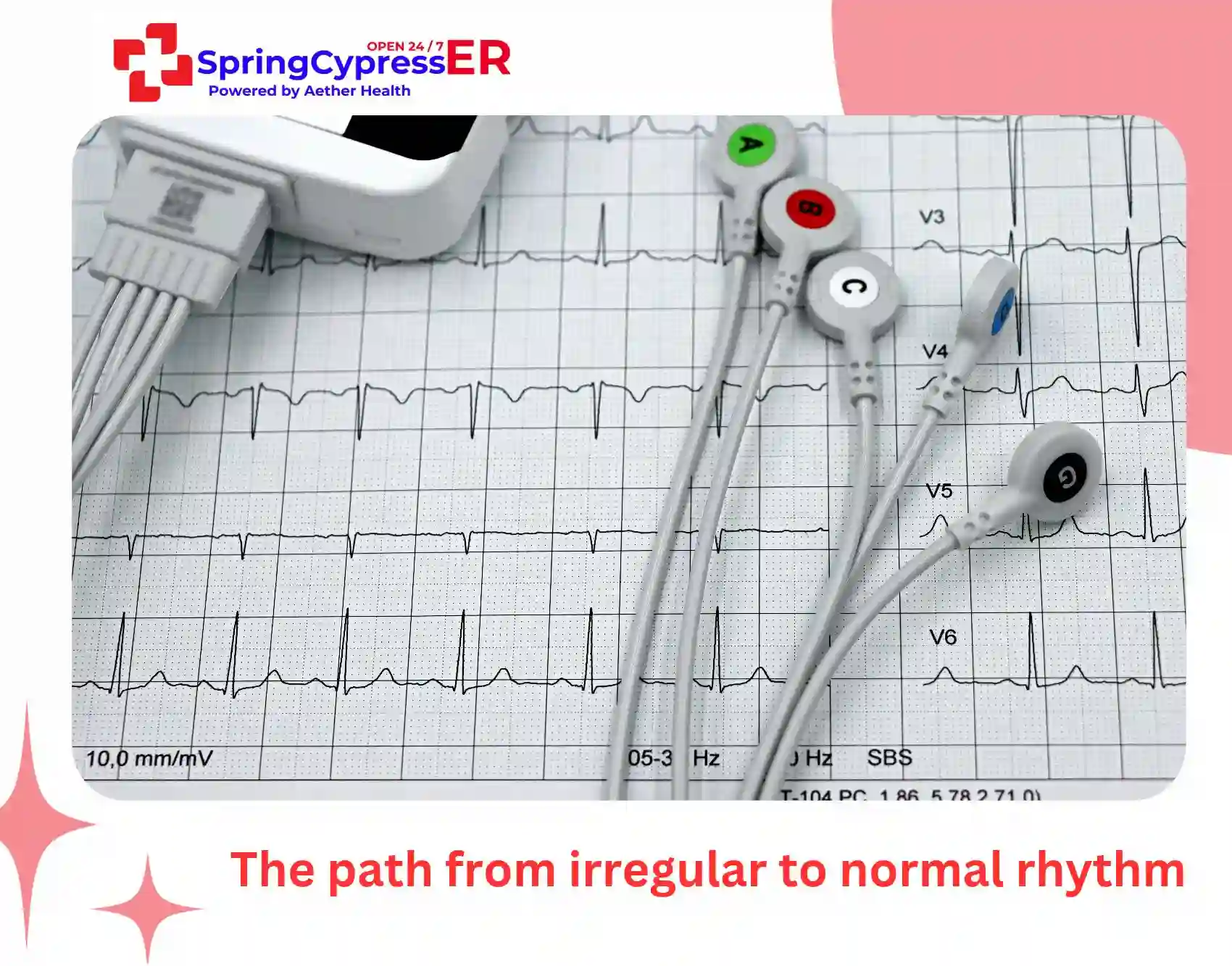
Every rhythm that returns to normal follows the same general path. Doctors diagnose the cause, address the trigger or treat the arrhythmia, and verify a return to sinus rhythm with an EKG. Each step can take minutes, days, or weeks depending on severity.
| Irregular rhythm detected | → | Diagnose cause | → | Address trigger | → | Normal rhythm |
Where you enter this path depends on your symptoms. Someone with occasional palpitations may start and finish within an outpatient visit. Someone with sustained AFib may enter through the ER and continue with a cardiology team for weeks or months.
Outlook by type of irregular heart beat
Not every arrhythmia has the same chance of returning to normal. The matrix below pairs each common rhythm with its realistic outlook. The sage rows are the most likely to self-resolve; the copper rows typically need treatment; the midnight row needs emergency evaluation.
| Type | Chance of returning to normal | How it usually happens |
|---|---|---|
| Caffeine or stress palpitations | Very high | Resolves on its own within hours of stopping the trigger |
| Premature beats (PACs, PVCs) | High for occasional ones | Often fade with lifestyle changes; frequent ones may need medication |
| Paroxysmal atrial fibrillation | Moderate | Converts on its own in hours; may need medication or cardioversion |
| Persistent atrial fibrillation | Moderate with treatment | Cardioversion or ablation can restore rhythm in many patients |
| Supraventricular tachycardia | High with treatment | Vagal maneuvers, medication, or ablation often provide full relief |
| Ventricular tachycardia | Variable | Needs immediate evaluation; some cases respond to medication or procedures |
Lifestyle resets that often restore normal rhythm
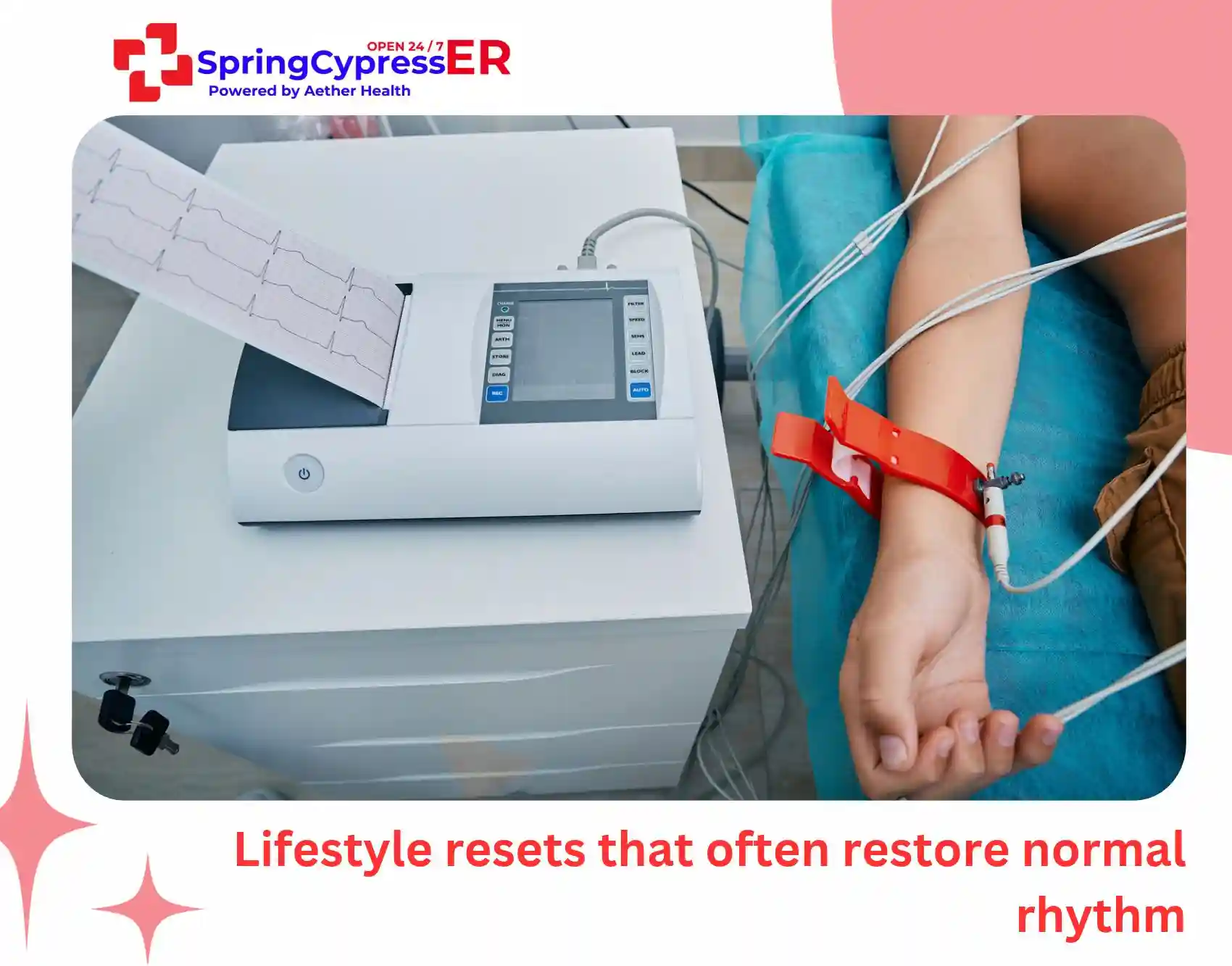
For rhythms driven by lifestyle factors, these six resets produce most of the gains. Each one addresses a known electrical or hormonal trigger. Patients evaluated at Aether Health Spring Cypress ER with benign palpitations often leave with a plan that leans heavily on these six moves plus a short cardiology follow-up.
| #1 Cut caffeine
Stop coffee, tea, and energy drinks for 7 days. Reintroduce slowly if rhythm stays steady. Many PACs and PVCs disappear in this one step. |
#2 Fix hydration
Aim for light-yellow urine throughout the day. Dehydration shifts electrolytes that trigger extra beats and short rhythm runs. |
| #3 Sleep 7 to 9 hours
Sleep debt lowers vagal tone and raises adrenaline. Both make the heart more electrically reactive. Consistency matters more than any single long night. |
#4 Treat thyroid and electrolytes
Blood work can reveal thyroid imbalance or low magnesium and potassium. Correcting these often restores normal rhythm. |
| #5 Address alcohol
Even moderate drinking can cause rhythm episodes the next day. Cutting back is one of the most effective lifestyle moves against AFib. |
#6 Manage weight and blood pressure
Each 10 percent weight loss and each sustained blood pressure improvement lowers the chance of AFib returning after treatment. |
Medical treatments that restore normal rhythm
When lifestyle resets are not enough, several medical options can restore normal rhythm. The Cleveland Clinic guide to arrhythmias lists these as the main approaches. For patients weighing long-term outlook, the companion guide on when you should be worried about an irregular heartbeat puts these treatments in context.²
- Vagal maneuvers: Breath holding, bearing down, or applying cold water to the face can reset SVT episodes at home or in the ER within seconds.
- Rhythm-control medications: Several medication categories slow abnormal electrical signals and help the heart hold a normal rhythm.
- Rate-control medications: A different category keeps heart rate steady even if the rhythm itself does not fully convert, often used for AFib.
- Electrical cardioversion: A controlled electrical pulse delivered under light sedation. Often restores sinus rhythm immediately for AFib and atrial flutter.
- Catheter ablation: A procedure that creates small scars to block the circuit driving the arrhythmia. Can be curative for SVT and many AFib cases.
- Treating the underlying condition: When thyroid disease, sleep apnea, or coronary artery disease is driving the rhythm, fixing the root cause often restores normal beats.
When an irregular heart beat needs ER evaluation to return to normal
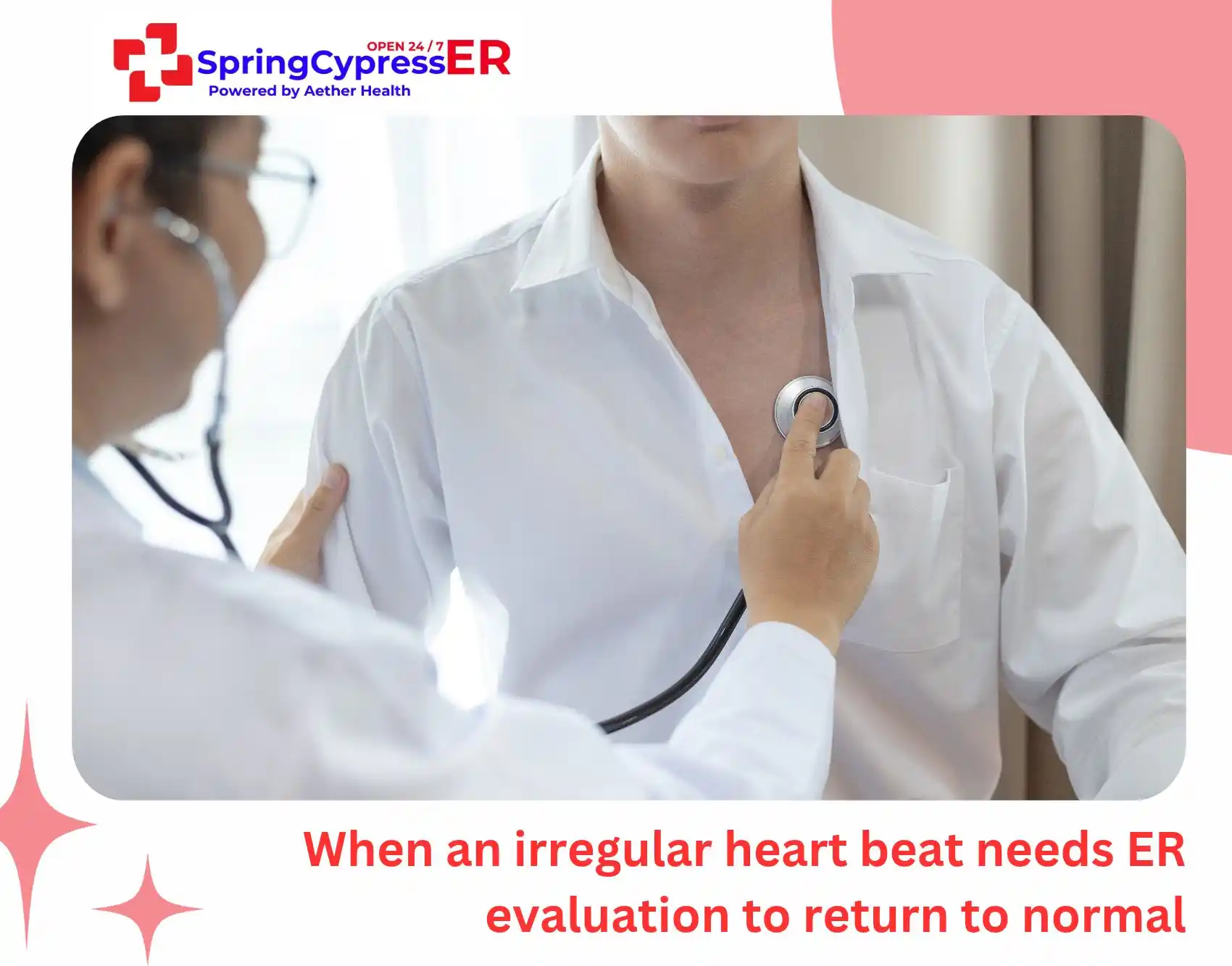
Some irregular rhythms cannot wait for a scheduled cardiology appointment. ER evaluation is appropriate when symptoms are severe, sudden, or combined with other warning signs. Rapid in-visit diagnosis helps start the path back to normal sooner.
Come to the ER right away for any of these signs:
- Palpitations with chest pain or pressure
- Sudden fainting or near-fainting
- Severe shortness of breath at rest
- New irregular heart beat in someone with known heart disease
- Rapid heart rate (over 150 bpm) that does not slow with rest
- Any new rhythm change in a pregnant patient or someone over 70
| Fast-track rhythm evaluation
Our emergency irregular heartbeat treatment delivers a 12-lead EKG, cardiac markers, and continuous monitoring in one visit. If rhythm needs to be restored right now, we initiate stabilization and coordinate direct cardiology transfer when required. |
Realistic timelines for rhythm to return to normal
Rhythm restoration happens on very different timescales depending on the cause. Set expectations ahead of time so progress can be tracked honestly.
- Minutes to hours: Lifestyle palpitations after caffeine or stress often resolve the same day. Vagal maneuvers can reset SVT in under a minute.
- Hours to days: Paroxysmal AFib frequently converts within 24 to 48 hours on its own or with medication.
- Days to weeks: After electrical cardioversion, many patients hold normal rhythm. Medication adjustments may continue for weeks.
- Weeks to months: Catheter ablation recovery takes weeks for scarring to stabilize. Rhythm improvements continue for months.
- Lifelong management: Some structural arrhythmias respond to treatment but need ongoing monitoring. This is different from being untreatable.
| Not sure if your rhythm concern needs the ER? Message or call our care team. 24/7, no appointment. |
Common questions
Q1. Can an irregular heart beat return to normal without medication?
Yes, for many lifestyle-driven rhythms. Cutting caffeine, correcting hydration, sleeping well, and treating thyroid or electrolyte issues often restores normal rhythm without medication. Structural arrhythmias usually need treatment.
Q2. How long can an irregular heart beat last before it becomes permanent?
AFib that lasts over 12 months is called long-standing persistent and becomes harder to convert. Many short episodes still respond to treatment years later, so there is rarely a point of no return for well-treated patients.
Q3. Does exercise help an irregular heart beat return to normal?
Moderate exercise and weight management lower AFib recurrence and help the heart hold normal rhythm. Avoid pushing through new palpitations during exercise. If a new rhythm appears during activity, stop and get evaluated.
Q4. Can anxiety-related irregular beats return to normal?
Yes. Anxiety-driven PACs and PVCs almost always resolve as stress subsides. Techniques like slow breathing, counseling, and regular sleep often produce quick rhythm improvements once anxiety is managed.
Q5. After cardioversion, how long does normal rhythm usually last?
Varies by patient. About half of cardioversion patients remain in sinus rhythm at one year without additional medication. Adding rhythm-control medication raises long-term success significantly.
Rhythm concerns in Spring, TX? Start the path back today
An EKG and basic labs can tell you within one hour which category of irregular heart beat you have and how likely it is to return to normal. Our freestanding ER opens its doors 24 hours a day with no appointment required.
Aether Health – Spring Cypress ER | Freestanding 24/7 Emergency Room
8929 Spring Cypress Rd, Spring, TX 77379 | (713) 528-8703
No appointment. Walk in any time.