
Reviewed by the emergency care team at Aether Health – Spring Cypress ER | 8929 Spring Cypress Rd, Spring, TX 77379 | +1 (713) 528-8703
If a burn is painless right now, come in: A painless burn is almost always a sign the burn is deeper and more serious not less. Do not wait. Call 911 or come to Aether Health – Spring Cypress ER immediately at 8929 Spring Cypress Rd. On-site emergency burn evaluation is available 24/7. Call +1 (713) 528-8703.
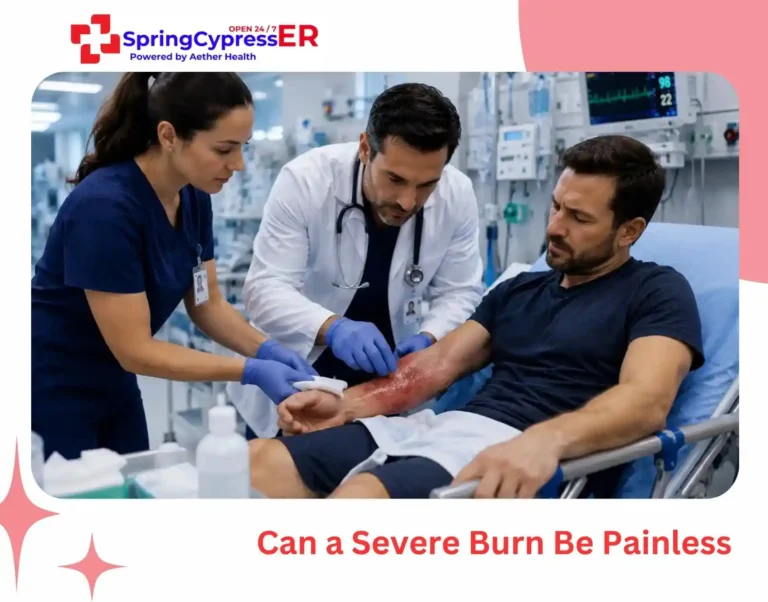
It seems like the worst burns should hurt the most but the opposite is often true. A burn so severe that it destroys the skin’s nerve endings can be strangely painless, feeling numb rather than agonizing. This counterintuitive truth is one of the most important things anyone dealing with a burn should understand because a painless burn is almost never a good sign.
This guide explains why severe burns can be painless, which burn degrees this affects, when painlessness signals a medical emergency, and how a freestanding emergency room like Aether Health – Spring Cypress ER evaluates and stabilizes serious burns. It is written by our emergency care team for Spring, Klein, and Cypress residents who need clear answers fast.
Quick Answer: Can a Severe Burn Be Painless?
Yes a severe burn can be painless, and painlessness is usually a sign the burn is MORE serious, not less. Third-degree and fourth-degree burns destroy the nerve endings in the skin. Without functioning nerve endings, there is nothing left to send pain signals to the brain.
The absence of pain in a burn is one of the most reliable indicators that professional emergency care is needed immediately. Painless does not mean minor. In fact, patients often describe their most severe burns as “strangely numb” or “like it isn’t there” and those descriptions almost always turn out to be signs of significant nerve damage.
Why Do Severe Burns Become Painless?
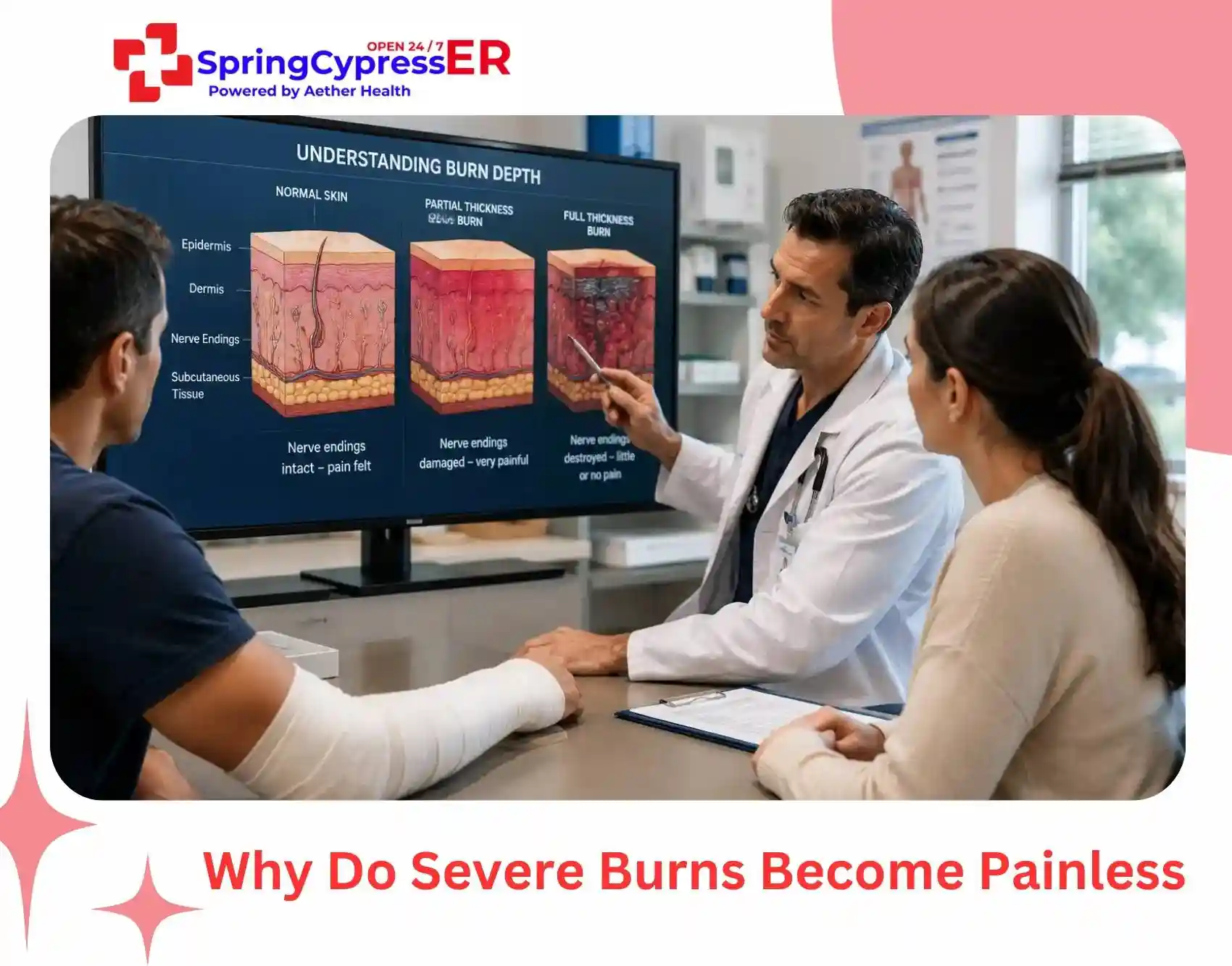
To understand why deep burns can be painless, it helps to know what’s happening beneath the skin’s surface because pain in a burn comes from nerve endings, and nerve endings can be destroyed.
The role of skin nerve endings
The skin is packed with sensory nerve endings that detect touch, temperature, and pain. In a superficial burn, these nerve endings are still intact they are just irritated and inflamed, which is why superficial burns hurt so intensely. As a burn goes deeper into the skin, it damages these nerves. Beyond a certain depth, the nerves are destroyed entirely.
What happens with deep burns
- In a third-degree burn, the burn extends completely through the skin both the epidermis (outer layer) and the dermis (deeper layer).
- The dermis contains most of the skin’s pain-sensing nerve endings.
- When the dermis is destroyed, so are the nerves in that area.
- The result: the center of a third-degree burn is often numb, while the edges where the burn transitions to second-degree can be intensely painful.
- Fourth-degree burns extend even deeper into muscle, tendon, or bone and the affected area is typically completely painless.
An important counterintuitive rule: The presence of pain does not always mean the burn is serious. The absence of pain in a burn almost always means the burn IS serious. Painless burns need emergency evaluation, without exception.
Pain Level by Burn Degree
Pain is one of the clues doctors and paramedics use to estimate burn depth but not the way most people expect. Here is how pain typically maps to burn severity.
| Burn Degree | Depth | How Painful It Usually Is |
|---|---|---|
| First-degree | Outer skin layer only (epidermis) | Painful like a sunburn. Nerve endings intact and irritated. |
| Second-degree | Outer and part of deeper skin layer (dermis) | Very painful often the most painful type. Nerves are exposed and inflamed. |
| Third-degree | Full skin thickness – through both layers | Often painless or numb at the center. Nerve endings destroyed. Painful around the edges (which are second-degree). |
| Fourth-degree | Extends into muscle, tendon, bone | Typically painless in the affected area deeper structures and nerves destroyed. |
Note that in real-world burns, especially larger ones, more than one burn degree is often present at the same time. The center may be third-degree (painless), while the surrounding areas are second-degree (extremely painful) and the outer edges are first-degree (mild). This is why patients sometimes describe a burn as “painful around the edges but numb in the middle” that is a classic sign of a third-degree burn and always needs emergency evaluation.
Other Reasons a Burn May Not Hurt at First
While painlessness in a burn is usually a sign of severity, there are a few other situations where a burn may feel less painful than expected. Even in these cases, the safest approach is to have a medical professional evaluate the injury.
- Immediate shock. In the first minutes after a serious injury, the body releases stress hormones that can temporarily blunt pain awareness. This natural response can make even a serious burn feel less painful in the first moments after it happens. Pain often intensifies significantly within 30 to 60 minutes.
- Cold water or ice contact. Cooling a burn quickly with room-temperature or cool water reduces pain by soothing the surrounding tissue. This is helpful first aid but can mask the underlying severity.
- Certain chemical burns. Some chemicals cause deep tissue damage with minimal initial sensation. Alkali burns (from drain cleaners, oven cleaners, lye) are especially notorious for this.
- Electrical burns. Electrical current can damage tissue deep beneath the skin while leaving the visible entry and exit points looking small and relatively painless.
- Nerve conditions or diabetes. People with diabetic neuropathy or other conditions affecting nerve function may not feel burns normally, especially on the feet.
- Very small superficial burns. A tiny first-degree burn such as a brief touch to a warm surface may not hurt significantly. This is different from a painless severe burn.
Warning Signs That a Painless Burn Is a Medical Emergency
If a burn is painless, the safest approach is to treat it as serious until a medical team confirms otherwise. But specific features raise the concern to “emergency, come in now.”
- The burn area looks white, brown, black, or charred.
- The skin has a leathery, dry, or waxy appearance.
- The burn edges are painful, but the center is numb.
- You cannot feel a gentle touch on the burned area.
- The burn is larger than the palm of the affected person’s hand.
- The burn is on the face, hands, feet, genitals, or over a major joint.
- The burn came from fire, electricity, or a chemical exposure.
- There is any breathing difficulty, coughing, or hoarseness after a burn.
- The burn is on an infant, young child, or older adult.
- The burn is accompanied by any other injury a fall, an explosion, or unconsciousness.
Do not wait it out: The most dangerous mistake with a painless burn is assuming it is minor because it doesn’t hurt. This is the opposite of the truth. Come to Aether Health – Spring Cypress ER for emergency severe burn treatment – or call 911 for any painless or numb burn. Call +1 (713) 528-8703.
What NOT to Do With a Painless Burn
Well-intentioned first aid can make a serious burn worse. Avoid these common mistakes.
- Do NOT apply ice directly to the burn. Ice can further damage already-injured tissue.
- Do NOT apply butter, toothpaste, egg whites, or home remedies. These trap heat and increase infection risk.
- Do NOT try to remove clothing that is stuck to the burn. Leave it in place for the medical team.
- Do NOT break any blisters.
- Do NOT wrap the burn tightly. Loose, clean covering is safer during transport.
- Do NOT drive yourself if the burn is extensive or involves the face, breathing, or unconsciousness. Call 911.
- Do NOT wait to see if pain develops. Painless already tells you what you need to know.
For a complete guide on immediate burn first aid before you arrive at the ER, see our companion article on how to treat severe burns.
When to Come to the ER for a Painless Burn
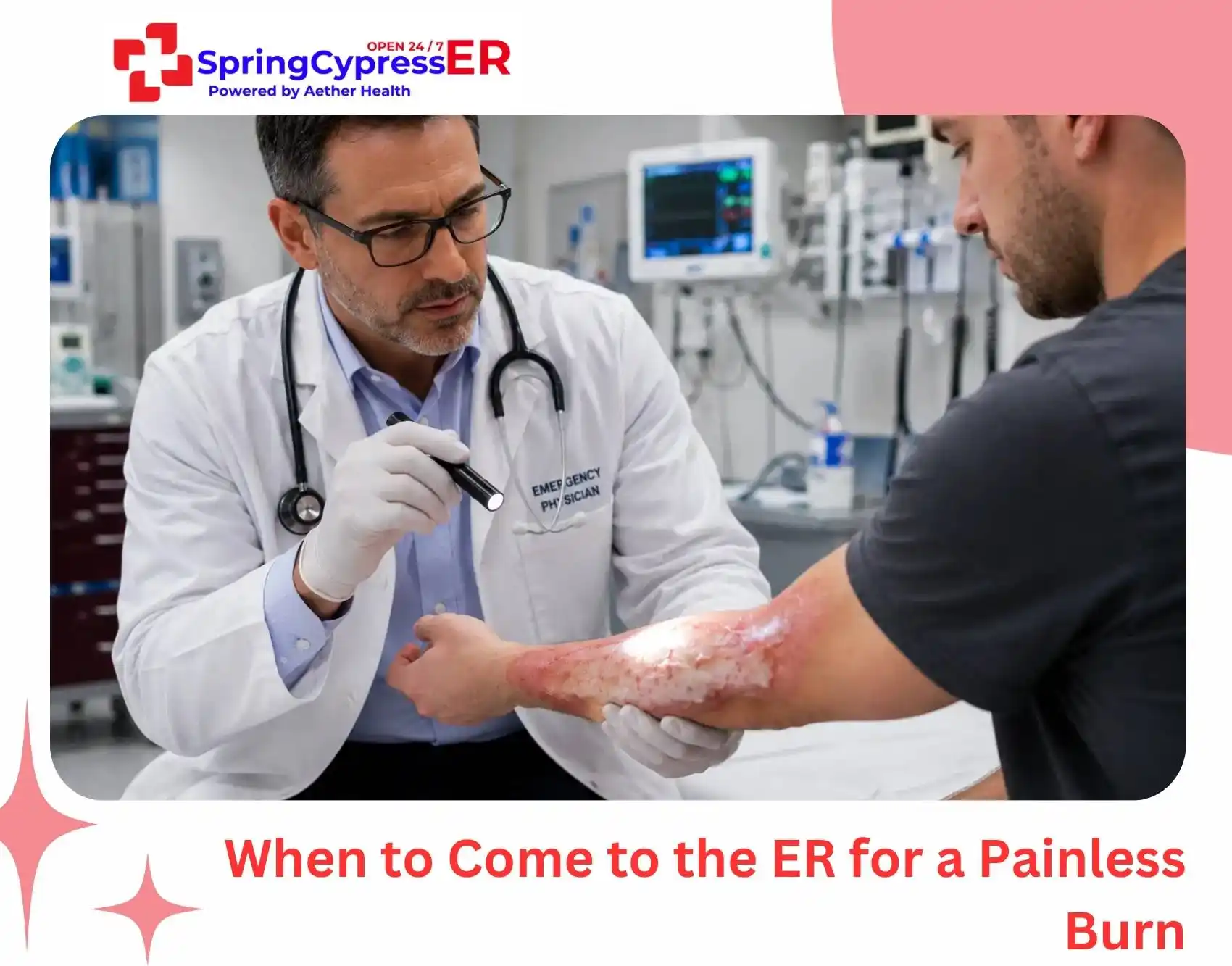
The short answer is: always. Every painless burn deserves professional emergency evaluation. The specific situations below are non-negotiable.
- Any burn that is painless in the center or across the whole area.
- Any burn where the skin looks white, brown, charred, or leathery.
- Any burn larger than the palm of a hand.
- Any burn on the face, hands, feet, genitals, or joints.
- Any burn from fire, electricity, chemicals, or radiation.
- Any burn accompanied by breathing trouble.
- Any burn in an infant, young child, or older adult.
- Any burn where you’re not sure of severity painless burns are exactly the situation where an in person assessment is essential.
Get evaluated fast: At Aether Health – Spring Cypress ER, severe burn stabilization and evaluation is available 24/7 with board-certified physicians, no wait, and same-visit imaging and lab work. For severe burns requiring specialized care, we coordinate rapid transfer to regional burn centers with full documentation. Call +1 (713) 528-8703 or come to 8929 Spring Cypress Rd.
How Aether Health – Spring Cypress ER Evaluates a Painless Burn
Our 24/7 freestanding ER in Spring, TX plays a critical role for burn patients providing rapid stabilization, accurate depth assessment, and coordinated transfer to specialized care when needed.
- Immediate physician evaluation board-certified emergency physicians on every shift, seeing patients within minutes of arrival.
- Airway assessment critical for burns involving the face, neck, or possible smoke inhalation. This is one of the highest priorities for any severe burn patient.
- Careful depth assessment the medical team examines the burn to identify areas of full-thickness (third-degree) damage that may be painless. Painless areas are documented and given priority attention.
- Body surface area calculation an accurate estimate of how much of the body is affected guides fluid support and transfer decisions.
- Vital sign and fluid support continuous monitoring during evaluation. Deep burns cause rapid fluid loss even when they don’t hurt.
- On-site diagnostic imaging CT, X-ray, ultrasound, and full laboratory testing to identify accompanying injuries and complications.
- Coordinated burn center transfer for burns that require specialized care, we arrange seamless transfer to regional burn centers with complete documentation.
For a complete overview of the multi-stage burn care journey, read our companion guide on how severe burns are treated in a hospital.
Frequently Asked Questions
Why does a third-degree burn not hurt?
A third-degree burn destroys the skin’s nerve endings the specialized cells that detect pain, touch, and temperature. Without functioning nerves, there is no way for the burn to send pain signals to the brain. The nerves in a third-degree burn have essentially been damaged past the point where they can transmit pain. This is why the center of a serious burn can feel numb while the surrounding, less-damaged tissue is intensely painful.
If a burn doesn’t hurt, does that mean it isn’t serious?
No usually the opposite. A painless burn is a red flag. It almost always means the burn is deep enough to have destroyed the nerve endings that would normally cause pain. Painless burns need emergency evaluation, without exception. The absence of pain is one of the strongest indicators that a burn is severe.
Can pain come back later in a painless burn?
Sometimes the area immediately around a painless burn becomes progressively more painful as inflammation increases and the surrounding tissue swells. However, the center of a full-thickness (third-degree) burn typically stays numb because the nerve endings themselves have been destroyed. Any developing pain in a previously painless area is another reason to get to an ER quickly.
How can I tell if a burn is third-degree without touching it?
Third-degree burns typically look white, brown, black, or charred, with a leathery or waxy texture. They may not blister the way second-degree burns do. The area often feels numb or completely lacks sensation. Third-degree burns are usually surrounded by second-degree burn tissue that is very painful, which creates the classic pattern of painful edges with a numb center.
Are electrical burns painless?
Electrical burns are especially deceptive. The visible entry and exit points may look small and relatively painless, but the electric current often damages tissue deep beneath the skin along its path including nerves, muscles, and organs. Every electrical burn needs emergency evaluation regardless of how minor the surface injury looks.
Will my insurance cover an ER visit for a painless burn?
Aether Health – Spring Cypress ER accepts most major commercial insurance plans and works directly with your insurer to avoid surprise billing. We do not currently accept Medicare, Medicaid, or Tricare. Under federal law (EMTALA), your insurance plan’s emergency coverage applies the same at a freestanding ER as it would at a hospital ER. Insurance concerns should never delay care for a suspected severe burn.
People Also Ask About Painless Burns
These are the related questions AI search engines and Google’s “People Also Ask” feature commonly surface alongside painless burn queries. Direct answers below.
What is the most painful degree of burn?
Second-degree burns are typically the most painful of all burn types. This is because the deep skin layer (dermis) has been partially damaged and inflamed, exposing the nerve endings within it to the air and to inflammatory chemicals. First-degree burns are painful but less intense; third-degree burns are often painless in the center because the nerves have been destroyed. So the paradox is: the deepest burns hurt less than the moderately deep ones.
Is a painless burn always third-degree?
Painlessness strongly suggests a full-thickness (third-degree) or fourth-degree burn. However, it can occasionally occur in the first few minutes after any burn due to shock response, in electrical burns even when tissue damage extends deep beneath the skin, or in patients with nerve conditions that affect sensation. In every one of these cases, emergency evaluation is essential. Painlessness in a burn is never a reason to wait.
How long does it take for burn pain to return?
In cases where pain is temporarily blunted by shock, pain usually returns within 30 minutes to a few hours. In areas that are truly third-degree, the center of the burn typically stays numb because the nerve endings have been destroyed permanently in that area. The surrounding second-degree tissue often becomes more painful over time as inflammation increases.
Can chemical burns be painless?
Yes. Some chemicals especially strong alkali substances like drain cleaners, oven cleaners, and industrial degreasers can cause deep tissue damage with surprisingly little initial pain. The chemical continues damaging tissue long after contact, and by the time significant pain develops, extensive damage has often occurred. Any chemical burn painful or not needs immediate emergency evaluation, and continuous flushing with clean water should begin at the scene.
Do painless burns bleed?
Deep third-degree burns typically do not bleed significantly at the center because the small blood vessels have been destroyed along with the tissue. They may appear dry, waxy, or leathery. Second-degree burns around the edges often produce clear fluid or blood as blisters break. The absence of bleeding at the center of a burn is another sign that suggests full-thickness damage.
Can I treat a painless burn at home?
No. Painless burns should never be treated at home. Any painless burn is likely a third-degree or fourth-degree burn that requires professional evaluation and stabilization. Home care cannot address the underlying damage and can delay the treatment that prevents complications. Come to the emergency room immediately for any painless burn, regardless of size or apparent severity.
Painless Burn? Get Emergency Care Now in Spring, TX

A painless burn is one of the clearest signs that professional emergency care is needed. Aether Health – Spring Cypress ER provides 24/7 emergency severe burn treatment with board-certified physicians, on-site imaging and lab work, and coordinated transfer to regional burn centers when needed usually within 60 minutes of arrival.
- Address: 8929 Spring Cypress Rd, Spring, TX 77379
- Phone: +1 (713) 528-8703
- Hours: Open 24 hours, every day of the year
- Contact: Get in touch with our team for questions or directions.
- Insurance: Most commercial plans accepted. No surprise billing.