
Reviewed by the emergency care team at Aether Health – Spring Cypress ER | 8929 Spring Cypress Rd, Spring, TX 77379 | +1 (713) 528-8703
You took a hit to the face during a game. Your child rubbed soap into their eye. A piece of debris flew up while you were mowing the lawn off Spring Cypress Road. The first question almost everyone asks is the same one: can this eye injury heal on its own, or do I need to see a doctor?
The honest answer is: it depends entirely on the type of injury. Some eye injuries clear up on their own within hours. Others can permanently damage your vision if they are not treated within the first day. This guide breaks down both categories clearly, so you know exactly when to wait it out and when to come straight to Aether Health – Spring Cypress ER for emergency eye care.
Quick Answer: When Eye Injuries Heal on Their Own and When They Don’t
Minor surface irritations and small scratches usually heal without medical care in a few hours to two days. Anything involving chemicals, sharp objects, blunt force, vision changes, or pain that worsens needs same-day emergency evaluation. When in doubt, get checked eye damage that looks minor on the outside can be serious on the inside.
Important: If you are reading this with active vision loss, severe pain, bleeding from the eye, or a chemical splash stop reading and call us at +1 (713) 528-8703 or come to 8929 Spring Cypress Rd, Spring, TX 77379. We are open 24/7 with no wait.
What Counts as an Eye Injury?
An eye injury is any trauma or irritation that affects the eye itself, the eyelid, the cornea (the clear front surface), the conjunctiva (the white part), or the surrounding bone and tissue. Eye injuries fall into five main categories, and knowing which one you are dealing with is the fastest way to figure out whether it can heal on its own.
- Surface irritations dust, sand, smoke, soap, or an eyelash trapped under the lid.
- Corneal abrasions scratches on the clear front of the eye, often from fingernails, contact lenses, or tree branches.
- Blunt trauma impact from a ball, fist, elbow, airbag, or fall.
- Penetrating injuries sharp objects, glass shards, or fishhooks entering the eye.
- Chemical and thermal burns household cleaners, pool chlorine, battery acid, hot oil, or welding flash.
Eye Injuries That Usually Heal on Their Own
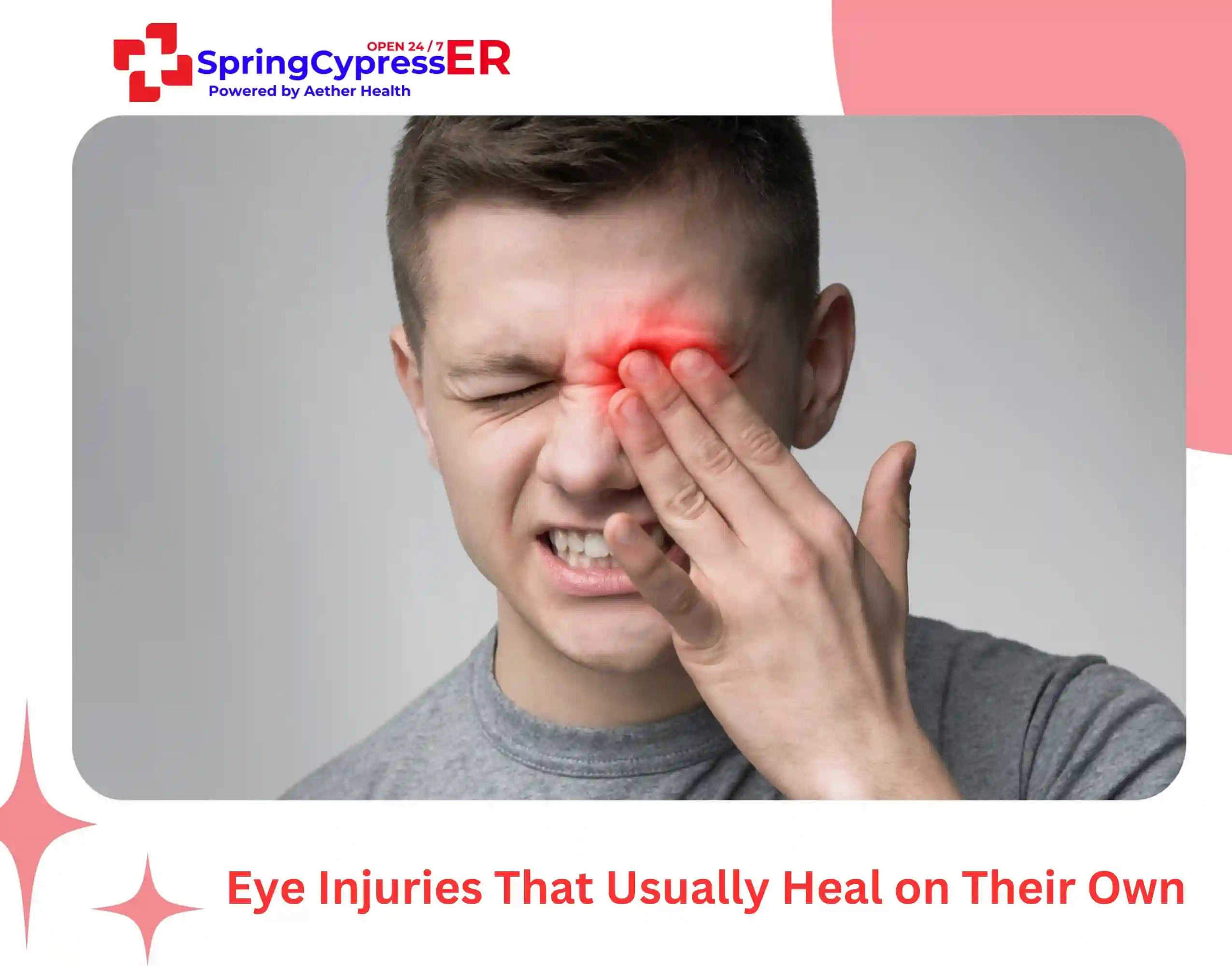
Several common eye injuries genuinely do recover without medical intervention, as long as the symptoms stay mild and improve over time. Here are the most frequent ones we see at our Spring, TX emergency room: the ones that did not actually need an ER visit.
1. Minor Surface Irritation
Getting dust, an eyelash, or a small particle in your eye triggers tearing, redness, and discomfort. In most cases your eye flushes the object out on its own within minutes. If it doesn’t, gently rinse with clean lukewarm water or saline for 15 to 20 seconds. Avoid rubbing, that’s the single biggest cause of an irritation turning into a scratch.
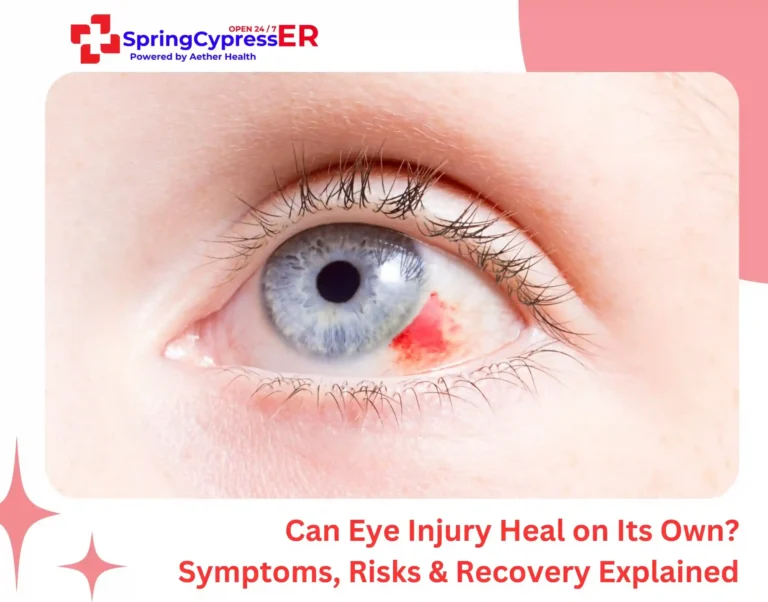
2. Subconjunctival Hemorrhage
This is the bright red patch on the white of the eye that often appears after a sneeze, cough, vomiting, or minor strain. It looks dramatic but it’s just a tiny broken blood vessel under the surface. There is no pain, no vision change, and no treatment needed. The blood reabsorbs naturally over one to two weeks. The only reason to see a doctor is if it keeps coming back, which can signal a blood-pressure or clotting issue.
3. Mild Corneal Scratch
A small, shallow scratch on the cornea usually from a fingernail or a contact lens often heals on its own within 24 to 48 hours because the cornea regenerates faster than almost any other tissue in the body. The catch: you cannot always tell how deep a scratch is. If pain, light sensitivity, or blurred vision is still present after 24 hours, or if it gets worse instead of better, come in immediately. Untreated deeper abrasions can develop into corneal ulcers.
4. Black Eye Without Vision Symptoms
A standard black eye bruising and swelling around the eye socket typically fades over one to two weeks, just like any other bruise. Use a cold compress for the first 24 hours, then warm compresses after that. You only need emergency care if you also notice double vision, trouble moving the eye, blood pooling inside the eye itself, or numbness around the cheekbone, all of which can mean a fracture of the orbital bone.
Eye Injuries That Do NOT Heal on Their Own
Some eye injuries get permanently worse without treatment and many of them look deceptively minor at first. These all require same-day evaluation at an emergency room with on-site imaging and slit-lamp capability.
1. Chemical Burns
Any chemical splash household cleaner, pool chlorine, bleach, ammonia, battery acid, lawn chemicals is a true ophthalmologic emergency. Alkaline chemicals (like drain cleaner) cause damage in seconds and continue burning long after the splash. Flush the eye with cool running water for at least 15 minutes, keep the eyelid open, and come straight to the ER. Do not wait to see if it improves.
2. Penetrating Eye Injuries
If a sharp object glass, metal shaving, fishhook, pencil has entered the eye, do not attempt to remove it. Cover the eye loosely with a paper cup or shield, avoid pressure, and get to the ER immediately. Removing a penetrating object outside a controlled medical setting can cause the eye’s fluid to leak and lead to permanent vision loss.
3. Blunt Force Trauma to the Eye
A hard impact from a baseball, fist, airbag, or fall can cause damage that you cannot see from the outside: retinal detachment, hyphema (blood pooling inside the eye), orbital fractures, or lens dislocation. The eye can look almost normal externally while bleeding internally. Any significant blunt impact deserves an ER evaluation, especially if there is pain, blurred vision, floaters, flashing lights, or trouble looking in all directions.
4. Deep Corneal Abrasions and Foreign Bodies
A deep scratch or a metal fragment lodged in the cornea will not heal cleanly without removal and antibiotic treatment. Left alone, these injuries can turn into corneal ulcers and scars that permanently blur vision. We use fluorescein staining and slit-lamp examination at our facility to find injuries you cannot see with the naked eye.
5. Thermal and UV Burns
Welding flash, sun-tanning bed exposure, and direct sun viewing during an eclipse can cause photokeratitis, essentially a sunburn on the cornea. Symptoms (intense pain, light sensitivity, tearing) often appear several hours after exposure. These need medical evaluation to rule out deeper damage and to manage pain properly.
Quick Reference: Does My Eye Injury Need Emergency Care?
Use this side-by-side table to match your injury type with the right next step.
| Eye Injury Type | Heals on Its Own? | Recommended Action |
| Minor surface irritation (dust, eyelash, smoke) | Yes within hours | Rinse with clean water. Do not rub. |
| Mild corneal scratch | Often within 24 to 48 hours | Monitor closely. Go to the ER if pain or vision worsens. |
| Subconjunctival hemorrhage (red patch on white of eye) | Yes within 1 to 2 weeks | Cosmetic only. See a doctor if recurring. |
| Black eye / bruising around the eye | Usually within 1 to 2 weeks | ER if vision changes or you cannot move the eye. |
| Deep corneal scratch or abrasion | No requires treatment | Same-day ER visit to prevent infection. |
| Chemical splash (cleaners, pool chemicals, bleach) | No emergency | Rinse for 15+ minutes, then go to the ER immediately. |
| Foreign object stuck in the eye | No do not remove it | Cover the eye (do not press) and come to the ER. |
| Blunt trauma (ball, fist, airbag, fall) | No risk of internal damage | ER evaluation, even if vision seems normal. |
| Penetrating injury (sharp object, glass) | No vision-threatening | Cover the eye and call 911 or come to the ER. |
Warning Signs You Must Come to the ER
Even if you are not sure what caused the injury, these red flags mean a same-day ER evaluation, no waiting it out, no urgent care detour.
- Any change in vision: blurring, double vision, partial loss, or flashes of light.
- Severe or worsening eye pain, especially with light sensitivity.
- Blood is visible inside the eye itself (not just on the white surface).
- A pupil that looks irregular in shape or different in size from the other eye.
- Inability to move the eye in all directions, or pain when trying.
- A foreign object you cannot rinse out, or one that is embedded.
- Chemical exposure of any kind.
- Eye injury combined with a head injury, loss of consciousness, or vomiting.
Don’t wait: Vision damage can become permanent within hours. If any of the above apply, call +1 (713) 528-8703 or come straight to Aether Health – Spring Cypress ER. We are open 24/7 with on-site imaging and zero wait time.
What to Do in the First 10 Minutes After an Eye Injury
These first-aid steps apply before you reach medical care. They can be the difference between a full recovery and a permanent vision problem.
- Do not rub the eye, even if it feels irritated. Rubbing turns minor irritations into abrasions and can push embedded objects deeper.
- For a chemical splash: flush the eye with cool clean water for at least 15 minutes, holding the eyelid open. Then come to the ER.
- For a foreign object you cannot see: try gentle blinking and rinsing. Do not use tweezers or cotton swabs on the eye surface.
- For a blow to the eye: apply a cold compress (not directly on the eyeball) to reduce swelling. Avoid taking aspirin or ibuprofen, which can worsen internal bleeding.
- For a penetrating injury: cover the eye loosely with a clean cup or shield. Never apply pressure or try to remove the object.
- Avoid eating or drinking on the way to the ER. You may need a procedure that requires an empty stomach.
How We Diagnose and Treat Eye Injuries at SpringCypress ER

Aether Health – Spring Cypress ER is fully equipped to evaluate and treat eye emergencies on site, with no transfer required for most cases. Our process is fast because every minute matters with eye trauma.
- Visual acuity testing measures exactly how well each eye sees, separately, to identify even subtle vision loss.
- Slit-lamp examination a high-magnification microscope that lets our physicians see microscopic damage to the cornea, lens, and anterior chamber.
- Fluorescein staining a harmless yellow dye that lights up scratches and abrasions invisible to the naked eye.
- On-site CT imaging available immediately if we suspect an orbital fracture, intraocular foreign body, or head injury.
- Foreign body removal performed on site by a board-certified emergency physician under anesthesia.
- Wound and abrasion treatment antibiotic drops, pain control, eye shields, and clear follow-up instructions.
- Ophthalmology referral for injuries that need a specialist, we coordinate same-day or next-morning follow-up so you don’t get lost in the system.
Recovery Timeline: What Affects How Quickly an Eye Injury Heals
Even injuries that heal on their own can take longer to recover when certain factors are in play. Knowing what to expect helps you spot a problem early.
- Age younger patients generally recover faster from corneal injuries; older adults heal more slowly and have higher infection risk.
- Diabetes slows corneal healing and increases infection risk significantly.
- Contact lens use lenses can trap bacteria against a healing surface. Stop wearing them until cleared by a doctor.
- Dry eye less natural lubrication means slower healing of even minor surface scratches.
- Rubbing or touching the single biggest cause of injuries that should have healed in 48 hours turning into week-long problems.
- Untreated infection any redness, pus, or worsening pain after day two means come back for re-evaluation.
How to Prevent Eye Injuries

Most eye injuries we treat in Spring, TX are preventable with simple precautions.
- Wear safety glasses for yard work, home repairs, woodworking, and welding.
- Use sports goggles for racquet sports, paintball, basketball, and baseball.
- Keep household chemicals labeled, sealed, and out of reach of children.
- Wash hands before inserting or removing contact lenses, and never sleep in lenses unless prescribed to.
- Use UV-protective sunglasses year-round in Texas long-term sun exposure damages the cornea.
- Keep children away from fireworks, BB guns, and laser pointers.
Frequently Asked Questions
How long does a scratched eye take to heal on its own?
A mild corneal scratch typically heals within 24 to 48 hours because the cornea regenerates very quickly. If pain, redness, or blurred vision is still present after two days, come to the ER a deeper scratch may have been missed.
Can I drive myself to the ER with an eye injury?
If one eye is fine and your vision in the uninjured eye is clear, short drives are usually possible but a ride is safer. Depth perception is reduced when one eye is bandaged or watering heavily. For chemical splashes or penetrating injuries, have someone drive you.
Should I go to urgent care or the ER for an eye injury?
Most urgent care clinics are not equipped with slit lamps, fluorescein staining, or on-site CT, which are essential for diagnosing eye trauma. A freestanding ER like Aether Health – Spring Cypress ER has all of these on site and is staffed by board-certified emergency physicians 24/7.
Will my insurance cover an ER visit for an eye injury?
Aether Health – Spring Cypress ER accepts most commercial insurance plans and works directly with your insurer to avoid surprise billing. We do not currently accept Medicare, Medicaid, or Tricare. Call us before or during your visit if you have coverage questions we are happy to help.
Can children’s eye injuries heal faster than adults’?
Generally yes younger tissue regenerates faster. But children are also less able to describe symptoms, and they rub their eyes more, which can make minor injuries worse. Any eye injury in a child that causes ongoing pain, light sensitivity, or refusal to open the eye should be evaluated.
Get Emergency Eye Care in Spring, TX Open 24/7, No Wait
When an eye injury is more than a minor irritation, every minute counts. At Aether Health – Spring Cypress ER, our board-certified emergency physicians and on-site diagnostic technology mean you walk in worried and walk out with answers fast.
- Address: 8929 Spring Cypress Rd, Spring, TX 77379
- Phone: +1 (713) 528-8703
- Hours: Open 24 hours, every day of the year
- Insurance: Most commercial plans accepted. No surprise billing.
Call Now: +1 (713) 528-8703 speak to our team in under 30 seconds. Or walk in any time at 8929 Spring Cypress Rd, Spring, TX 77379.