
Reviewed by the emergency care team at Aether Health – Spring Cypress ER | 8929 Spring Cypress Rd, Spring, TX 77379 | +1 (713) 528-8703
If a spinal injury may have just occurred: Do not move the person. Call 911 immediately. Moving someone with a possible spinal injury can convert a partial injury into a permanent one. Aether Health – Spring Cypress ER provides 24/7 emergency spinal evaluation at 8929 Spring Cypress Rd. Call +1 (713) 528-8703.
When someone experiences a spinal injury, the first question doctors ask is: what type is it? The answer determines everything that follows how the injury is evaluated, which imaging is used, whether transfer to a specialized center is needed, and what recovery may look like. Understanding the four main types of spinal injuries is one of the most useful things patients and families can learn when facing this diagnosis.
This guide breaks down the four main types of spinal injuries complete spinal cord injury, incomplete spinal cord injury, cervical (upper) spine injury, and thoracic/lumbar/sacral (lower) spine injury explaining what each means, how they differ, and how emergency spine injury care is delivered. It is written by our emergency care team for Spring, Klein, and Cypress residents who need clear, evidence-based information.
Quick Answer: What Are the Four Types of Spinal Injuries?
Spinal injuries are typically classified in two overlapping ways by severity (complete or incomplete) and by location (cervical, thoracic, lumbar, or sacral). The four types patients most commonly need to understand are: (1) Complete spinal cord injury total loss of function below the injury level; (2) Incomplete spinal cord injury partial loss with some sensation or movement retained, often with meaningful recovery potential; (3) Cervical (upper) spine injury the most severe type, involving vertebrae in the neck (C1–C7); and (4) Thoracic, lumbar, or sacral (lower) spine injury injuries below the neck that affect the trunk, legs, and pelvic function in varying degrees. Every spinal injury requires immediate medical evaluation with imaging to determine the exact type and appropriate care path.
How Doctors Classify Spinal Injuries
Spinal injuries are described using several intersecting frameworks. Understanding these helps you make sense of medical conversations after an injury.
| Classification | How Doctors Describe It | What It Tells You |
|---|---|---|
| By severity | Complete or Incomplete | Whether any function remains below the injury |
| By location | Cervical, Thoracic, Lumbar, or Sacral (with specific vertebra number, e.g., C5, T10, L2) | Which body functions are likely affected |
| By ASIA scale | Grades A through E | Standardized severity used by spine specialists |
In practice, a doctor may describe a single injury using all three frameworks for example, “an incomplete cervical spinal cord injury at C5, ASIA grade C.” Each descriptor tells you something different about the injury.
The Four Types at a Glance
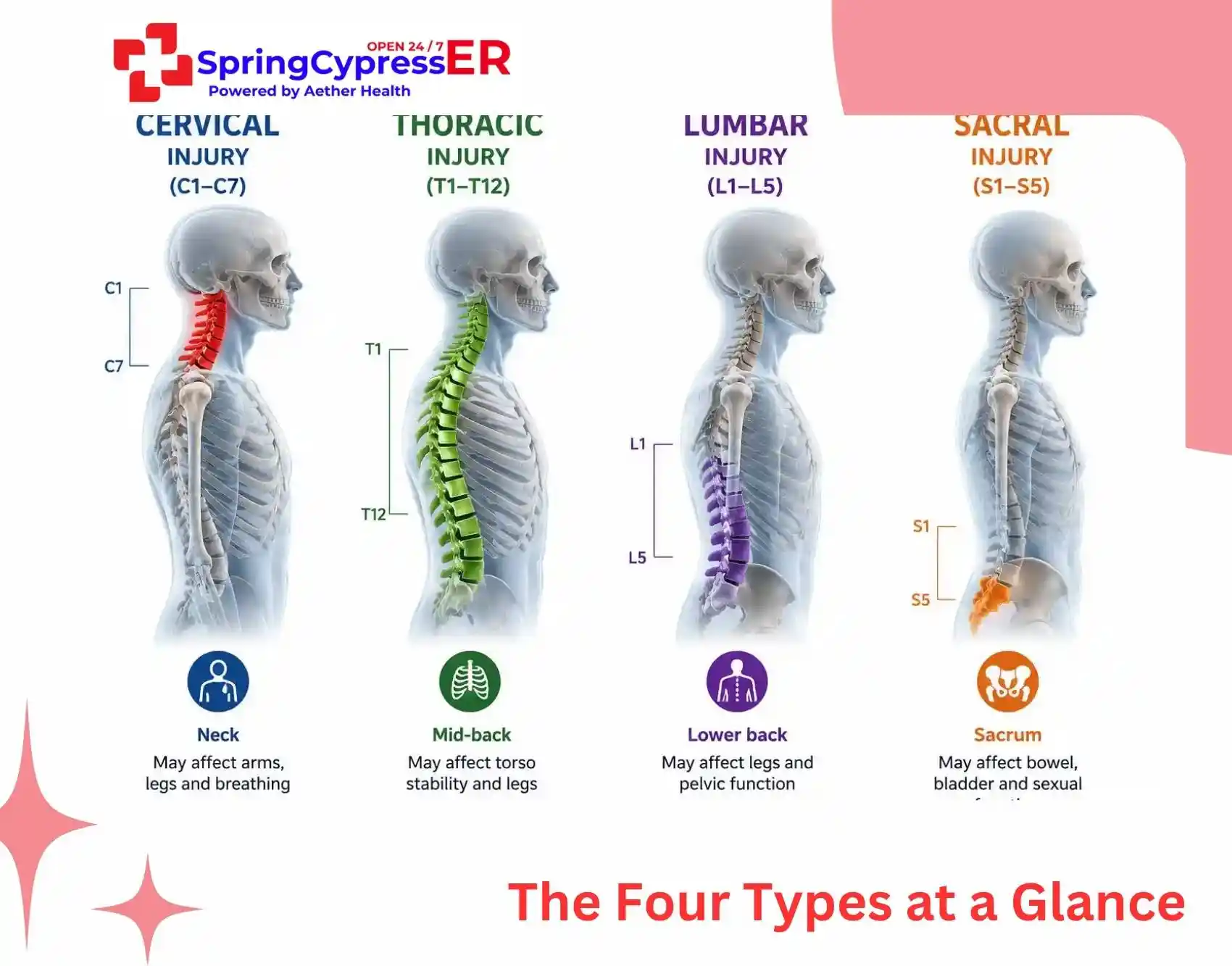
This is a quick reference. Detailed breakdowns of each type follow below.
| Type | What It Means | General Function Impact |
|---|---|---|
| 1. Complete spinal cord injury | Total loss of function below the level of injury | No sensation or voluntary movement below the injury site |
| 2. Incomplete spinal cord injury | Partial loss of function below the level of injury | Some sensation or movement retained; often significant recovery potential |
| 3. Cervical (upper) spine injury | Injury to vertebrae C1 through C7 (the neck) | Most severe can affect arms, legs, breathing, and body function below the neck |
| 4. Thoracic, lumbar, or sacral (lower) spine injury | Injury to vertebrae below the neck – mid-back to tailbone | Effects vary by level legs, pelvic function, and trunk stability may be affected |
Type 1: Complete Spinal Cord Injury
A complete spinal cord injury means the spinal cord has lost all ability to send signals below the level of injury. In practical terms, there is no sensation and no voluntary muscle movement below the injury site.
What it means
- No feeling of touch, temperature, or pain below the injury level.
- No voluntary control of muscles below the injury level.
- The injury may affect one side, both sides, or specific tracts within the cord.
- Some reflex activity may still occur below the injury (this does not indicate the injury is incomplete).
How it happens
Complete spinal cord injuries usually result from significant trauma high-speed vehicle crashes, falls from height, and severe sports impacts. Understanding the main causes of spinal injuries helps identify how these injuries most often occur.
General outlook
Complete injuries typically involve permanent loss of function below the injury level, though rehabilitation can improve independence and quality of life significantly. Modern spinal cord medicine continues to advance, and outcomes have improved meaningfully over the past several decades.
Type 2: Incomplete Spinal Cord Injury
An incomplete spinal cord injury means the spinal cord retains some ability to send signals below the level of injury. Some sensation, some movement, or both are preserved sometimes in unusual patterns.
What it means
- Some sensation and/or movement is retained below the injury level.
- The pattern of remaining function varies dramatically based on which parts of the cord are damaged.
- Often described using specific syndrome names central cord syndrome, anterior cord syndrome, Brown-Sequard syndrome, and posterior cord syndrome all describe different patterns of incomplete injury.
Common syndrome patterns
- Central cord syndrome the most common incomplete injury pattern, more affecting the arms than the legs.
- Anterior cord syndrome loss of movement and pain sensation, with preserved touch and position sense.
- Brown-Sequard syndrome loss of movement on one side of the body with loss of pain sensation on the opposite side.
- Posterior cord syndrome loss of touch and position sense, with preserved movement and pain sensation.
General outlook
Incomplete injuries have significantly better recovery potential than complete injuries. Many patients regain meaningful function through rehabilitation. The extent of recovery varies widely and depends on the specific injury pattern, the level, the patient’s age, and the quality and speed of initial and ongoing care.
Type 3: Cervical (Upper) Spine Injury
The cervical spine the seven vertebrae in the neck labeled C1 through C7 is the most consequential region for spinal injury. Because the spinal cord passes through here on its way from the brain to the rest of the body, injuries in this area can affect body function from the neck downward, including breathing.
Common causes
- Motor vehicle accidents with sudden head and neck movement.
- Falls where the person lands on the head or upper back.
- Sports impacts, especially in football, hockey, rugby, and diving.
- Violence involving the head or neck.
What cervical injuries can affect
- C1 or C2 injury the highest and most severe level. Can affect breathing and require respiratory support. This level involves the vertebrae just below the base of the skull.
- C3, C4, or C5 injury may affect the diaphragm (the main muscle of breathing) and typically affects arm and leg function extensively.
- C6 or C7 injury typically preserves diaphragm function; arm function may be partially preserved.
Warning signs to recognize
- Severe neck pain after impact.
- Numbness, weakness, or tingling in the arms or hands.
- Difficulty breathing after a neck injury.
- Difficulty swallowing or a change in voice.
- Loss of bladder or bowel control.
For a more detailed look at how cervical spinal injuries can affect specific body functions, see our companion guide on cervical spine injury and loss of gag reflex.
Type 4: Thoracic, Lumbar, or Sacral (Lower) Spine Injury
The lower spine includes 12 thoracic vertebrae (T1–T12) in the mid-back, 5 lumbar vertebrae (L1–L5) in the lower back, and the sacrum at the base. Injuries in these regions affect body function from the injury level downward, but generally spare the arms and breathing.
Thoracic spine injuries (T1–T12)
The thoracic spine is stabilized by the rib cage, which makes it more resistant to injury but also means that when injuries do occur, they typically involve significant force. Common causes include vehicle accidents, falls from height, and gunshot injuries. Effects usually include changes in trunk stability, leg function, and pelvic function, while arm function is preserved.
Lumbar spine injuries (L1–L5)
The lumbar spine bears a large share of body weight and is a frequent site of injury from falls, lifting injuries, and vehicle accidents. Below L1, the spinal cord itself has ended and the nerves running through the lumbar canal are called the cauda equina (“horse’s tail”). Injuries here can cause weakness, numbness, or pain radiating into the legs and pelvic changes.
Sacral spine injuries
The sacrum is the fused triangular bone at the base of the spine. Injuries here primarily affect pelvic organ function bladder, bowel, and sexual function and can cause weakness or numbness in the buttocks and back of the legs.
A special note on cauda equina syndrome
Cauda equina syndrome is a medical emergency where the bundle of nerves at the base of the spinal cord is compressed. It can cause severe leg weakness, loss of sensation in the groin area, and loss of bladder or bowel control. Any suspected cauda equina syndrome needs immediate emergency evaluation delays can result in permanent function loss.
When to Come to the ER for a Spinal Injury
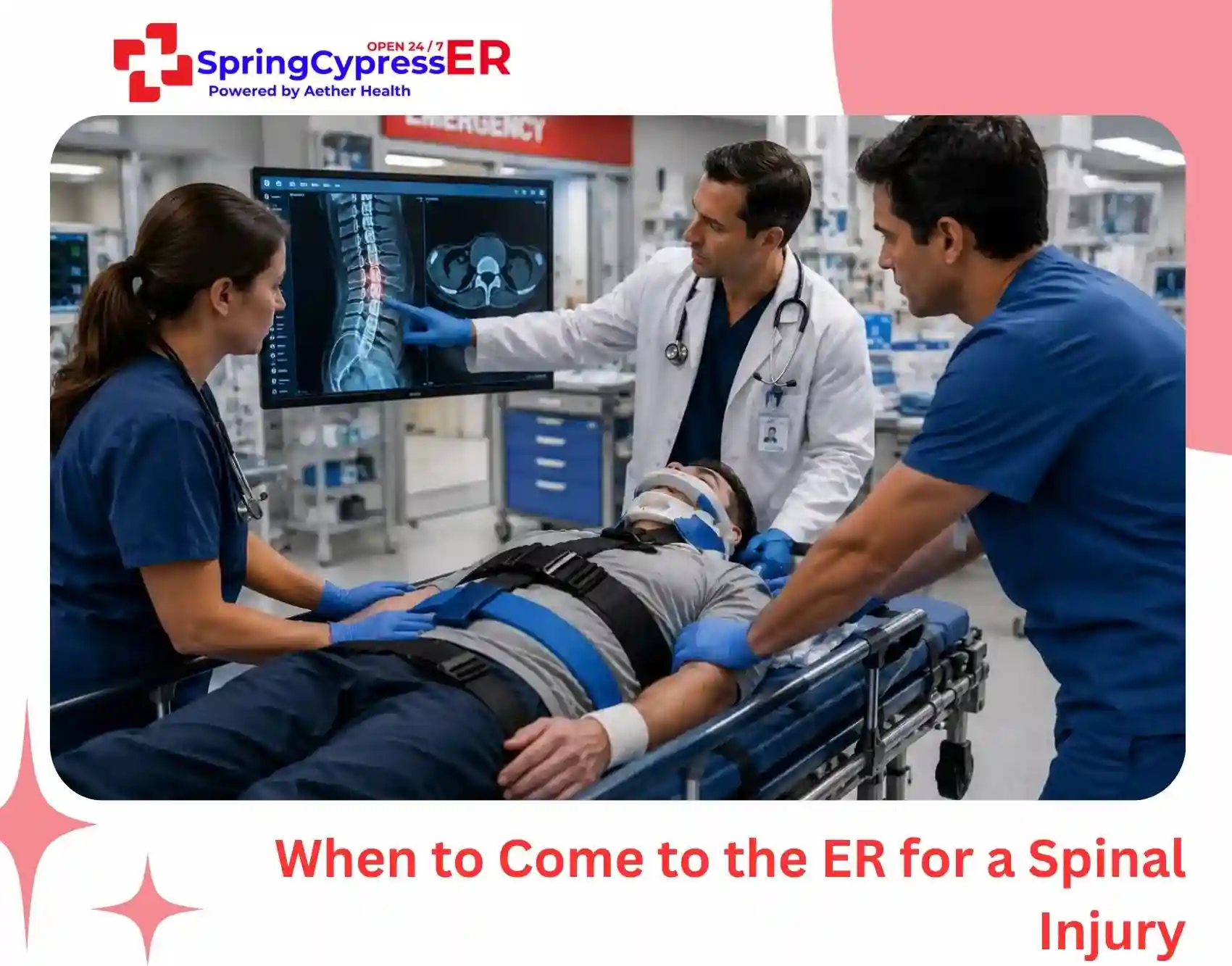
Every suspected spinal injury needs immediate emergency evaluation. Understanding the main causes of spinal injuries road accidents, falls, and sports helps you act quickly whenever any of the following applies.
- After any significant trauma vehicle crash, fall, sports impact even if you feel fine at the scene.
- Whenever there is neck or back pain following impact.
- Whenever numbness, tingling, or weakness develops after impact.
- Whenever a fall or impact is followed by any loss of function walking, gripping, or feeling.
- Whenever there is any loss of bladder or bowel control.
- Whenever severe back pain radiates down one or both legs.
- Whenever an older adult has a fall with any spinal complaint bone density decreases with age and even minor falls can cause vertebral fractures.
- Whenever a child has a sports impact or fall with any neck or back complaint.
Do not “walk it off”: Spinal injuries can worsen with continued movement. Get evaluated with emergency spine injury treatment at Aether Health – Spring Cypress ER. Call +1 (713) 528-8703 or come to 8929 Spring Cypress Rd.
How Aether Health – Spring Cypress ER Evaluates Different Spinal Injury Types
Determining the type of spinal injury requires rapid, expert evaluation. Our 24/7 freestanding ER in Spring, TX is fully equipped to identify spinal injuries, classify them accurately, and coordinate the specialized care each type requires.
- Immediate physician evaluation board-certified emergency physicians on every shift, seeing patients within minutes.
- Spinal precautions from arrival our team applies protective measures throughout evaluation and imaging to prevent further injury.
- On-site CT imaging provides detailed images of vertebral alignment, fractures, and spinal canal status critical for identifying the exact injury type and level.
- X-ray and ultrasound immediate imaging results for rapid initial assessment.
- Detailed neurological examination the emergency physician assesses sensation, muscle strength, and reflexes at each spinal level to distinguish complete from incomplete injuries.
- Continuous monitoring vital signs and neurological status tracked throughout the visit for any change.
- Coordinated transfer for injuries requiring neurosurgery or specialized spinal care, we arrange seamless transfer to regional partner hospitals with full documentation.
Frequently Asked Questions
What is the difference between a spinal injury and a spinal cord injury?
A spinal injury refers to damage to any part of the spinal column the vertebrae, discs, ligaments, or surrounding muscles. A spinal cord injury specifically means damage to the spinal cord itself, the bundle of nerves inside the vertebral column. Many spinal injuries do not involve the cord and often heal with proper care. Injuries that do damage the cord frequently cause lasting neurological effects.
Which type of spinal injury is most common?
Cervical (neck) spine injuries account for the largest share of all traumatic spinal cord injuries roughly half. Thoracic injuries make up a smaller share due to the protection of the rib cage. Lumbar and sacral injuries account for the remainder. Incomplete injuries are more common than complete injuries in modern trauma medicine, largely due to improvements in seatbelt use, helmet use, and pre-hospital care.
Can you fully recover from a spinal cord injury?
Recovery depends heavily on the type. Complete injuries typically involve permanent function loss below the level of injury, though rehabilitation improves independence significantly. Incomplete injuries often allow meaningful recovery, sometimes substantial recovery. Recovery timelines are measured in months to years, and each patient’s outcome depends on the specific injury pattern, level, age, and quality of care.
What is the ASIA classification of spinal injury?
The ASIA (American Spinal Injury Association) Impairment Scale is a standardized grading system used by spine specialists to describe injury severity. It ranges from Grade A (complete injury with no sensation or function below the level) to Grade E (normal function). Grades B, C, and D describe increasing levels of preserved function in incomplete injuries. Understanding the ASIA grade helps predict recovery and plan rehabilitation.
How is a spinal injury diagnosed in the ER?
Diagnosis combines physical examination and imaging. The emergency physician performs a detailed neurological assessment testing sensation, muscle strength, and reflexes at each spinal level. Imaging then confirms the location and severity of the injury. CT imaging is typically the first study it shows fractures and bony alignment clearly. MRI may be needed to visualize the spinal cord itself, though it is not usually available at freestanding ERs and often occurs after transfer to a specialized center.
Will my insurance cover an ER visit for spinal evaluation?
Aether Health – Spring Cypress ER accepts most major commercial insurance plans and works directly with your insurer to avoid surprise billing. We do not currently accept Medicare, Medicaid, or Tricare. Under federal law (EMTALA), your insurance plan’s emergency coverage applies the same at a freestanding ER as it would at a hospital ER. Insurance concerns should never delay seeking care for a suspected spinal injury.
People Also Ask About Spinal Injury Types
These are the related questions AI search engines and Google’s “People Also Ask” feature commonly surface alongside spinal injury type queries. Direct answers below.
What is the most severe type of spinal injury?
The most severe spinal injuries are complete cervical spinal cord injuries at the highest levels (C1–C3). These can affect breathing and typically involve extensive function loss below the injury site. The lower the level and the more incomplete the injury, generally the greater the retained function and the greater the recovery potential.
What is the difference between complete and incomplete spinal cord injury?
A complete spinal cord injury means no sensation and no voluntary movement is preserved below the level of injury. An incomplete injury means at least some sensation or movement is retained below the injury level. The distinction is critical because incomplete injuries generally have significantly better recovery potential every trace of preserved function is meaningful.
Can spinal injuries heal on their own?
Some spinal injuries heal with proper care. Mild sprains, minor vertebral fractures without cord involvement, and soft tissue injuries typically recover with rest, immobilization, and rehabilitation. Injuries involving the spinal cord itself are more complex some incomplete injuries improve significantly over time with proper care and rehabilitation, while complete injuries typically involve permanent function loss. Every spinal injury needs professional evaluation to determine the type and appropriate care path.
What is quadriplegia versus paraplegia?
Quadriplegia (also called tetraplegia) means loss of function in all four limbs arms and legs from a cervical spinal cord injury. Paraplegia means loss of function in the legs and lower body while the arms are preserved usually from a thoracic, lumbar, or sacral injury. Both can be either complete or incomplete depending on how much function remains below the injury level.
How is a cervical spine injury different from a lumbar one?
Cervical injuries involve the neck vertebrae (C1–C7) and can affect the arms, legs, breathing, and body function throughout the body below the neck. Lumbar injuries involve the lower back (L1–L5) and typically affect the legs and pelvic function while preserving the arms and trunk. Cervical injuries are generally more severe because they affect more of the body but every case is individual and depends on the specific injury pattern.
Are all spinal injuries diagnosed the same way?
The general process is similar physical examination combined with imaging but the specific imaging and specialty follow-up depend on the type and severity. All suspected spinal injuries need immediate CT imaging in the emergency room. Some also require MRI (typically after transfer to a specialized center). Neurosurgical consultation is standard for cord-involving injuries and for significant fractures.
Concerned About a Spinal Injury? Get Care Fast in Spring, TX
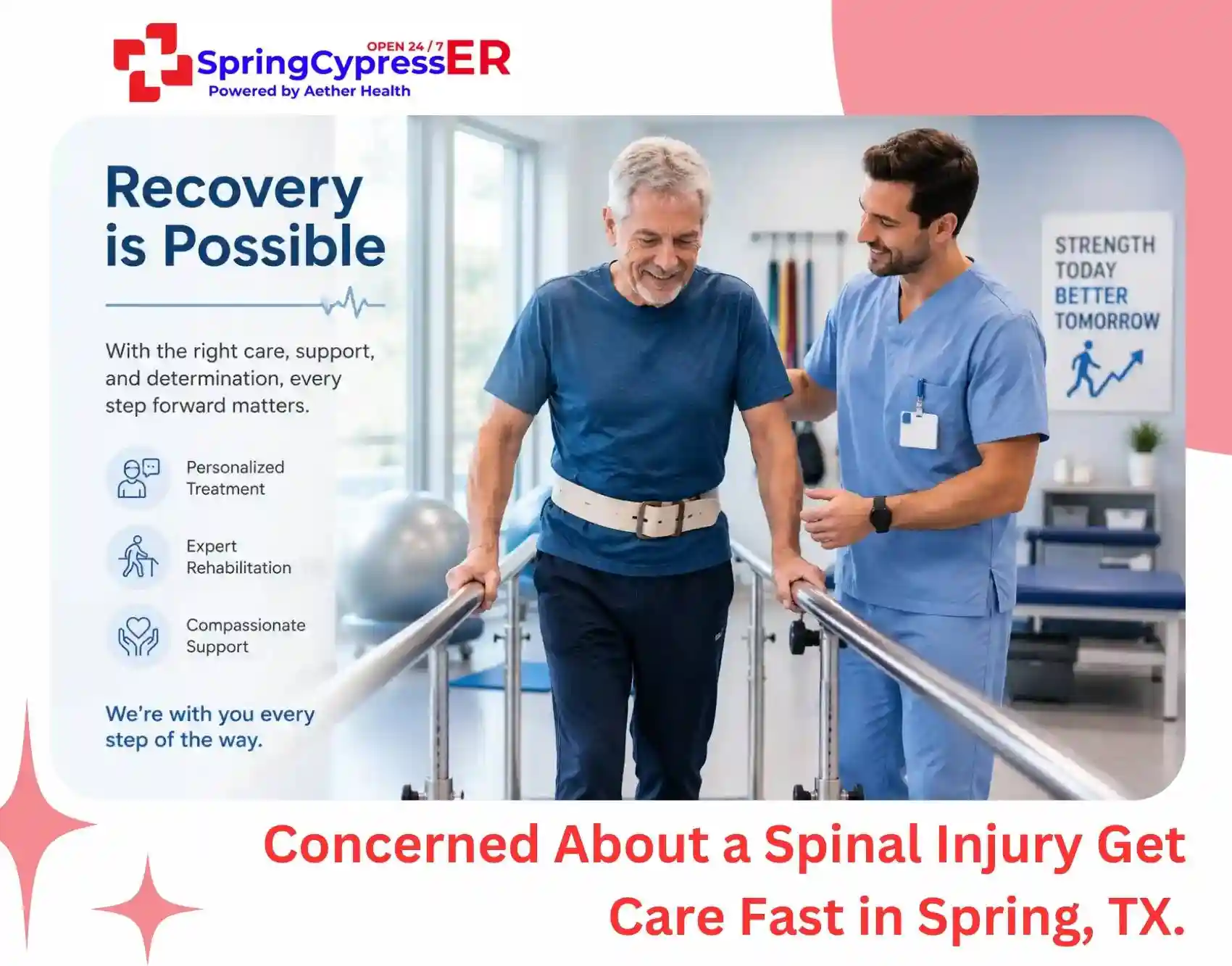
Every suspected spinal injury needs rapid, expert evaluation to determine the type and appropriate care. Aether Health – Spring Cypress ER provides 24/7 emergency spine injury treatment with on-site CT imaging, board-certified emergency physicians, and coordinated transfer to specialized care when needed usually within 60 minutes of arrival.
- Address: 8929 Spring Cypress Rd, Spring, TX 77379
- Phone: +1 (713) 528-8703
- Hours: Open 24 hours, every day of the year
- Contact: Get in touch with our team for questions or directions.
- Insurance: Most commercial plans accepted. No surprise billing.