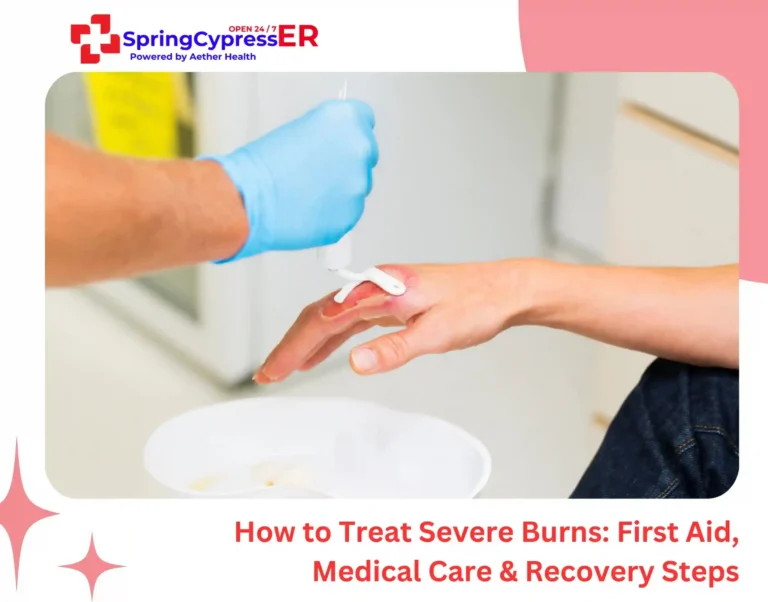
Reviewed by the emergency care team at Aether Health – Spring Cypress ER | 8929 Spring Cypress Rd, Spring, TX 77379 | +1 (713) 528-8703
A grease fire on the stove. A child who pulled a hot coffee mug off the counter. A chemical splash in the garage. Severe burns happen fast and what you do in the first five minutes can make the difference between a clean recovery and lifelong scarring.
This guide walks you through exactly how to treat severe burns: the first-aid steps that actually help (and the popular ones that make burns worse), how to identify when a burn is serious enough to need emergency care, what we do at Aether Health – Spring Cypress ER to treat burns safely, and how to support healing through the weeks that follow.
Quick Answer: How to Treat a Severe Burn
To treat a severe burn: remove the person from the source of heat, cool the burn with cool (not cold) running water for 20 minutes, cover it loosely with a clean non-stick cloth, and get to an emergency room immediately. Do not apply ice, butter, oil, or toothpaste. Do not pop blisters. Do not remove clothing stuck to the burn. Severe burns anything larger than the palm of your hand, on the face, hands, feet, joints, or genitals, or burns that look white, brown, charred, or leathery require same-day emergency evaluation to prevent infection, fluid loss, and scarring.
Burn happening right now?: If the burn is large, deep, on the face or hands, caused by chemicals or electricity, or the person is having trouble breathing call 911. For all other severe burns, cool the area with running water and come straight to Aether Health – Spring Cypress ER. We are open 24/7 at 8929 Spring Cypress Rd, Spring, TX 77379. Call +1 (713) 528-8703.
Understanding Burn Severity: The 4 Degrees of Burns
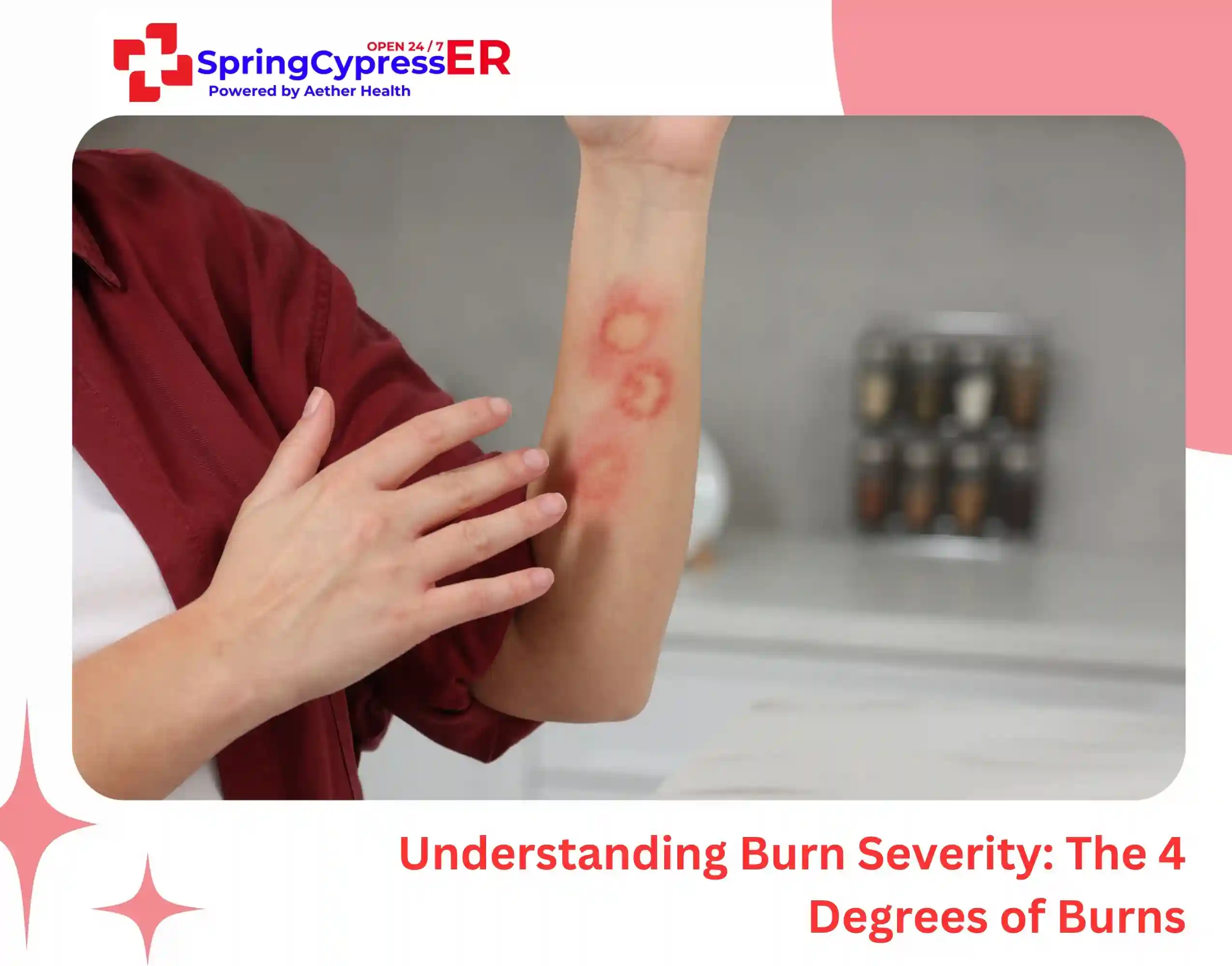
Treatment depends entirely on how deep the burn goes. A burn that looks scary on the surface may be less serious than a burn that looks pale and painless that’s because the deeper the burn, the more nerve damage, and the less pain the patient feels. Identifying the degree is the first step in deciding what to do next.
| Burn Degree | How It Looks & Feels | Heals on Its Own? | Recommended Action |
| First Degree | Red, dry, painful; no blisters. Like a sunburn. | Yes 3 to 7 days | Home care; ER only if widespread or on the face |
| Second Degree (superficial) | Red, wet, blistered, very painful. | Usually 2 to 3 weeks | ER if larger than your palm, on hands, face, joints, or genitals |
| Second Degree (deep) | Pale or red-and-white, less painful than expected, blistered. | No needs medical care | Same-day ER visit |
| Third Degree | White, brown, black, or charred; leathery; little or no pain. | No emergency | Call 911 or come to the ER immediately |
| Fourth Degree | Reaches muscle, tendon, or bone; charred appearance. | No life-threatening | Call 911 immediately |
Important: Even a small third- or fourth-degree burn is a medical emergency. Severity is not just about size it’s about depth, location, and cause.
First Aid for Severe Burns: Step-by-Step
What you do in the first 5 to 20 minutes after a burn directly affects how deep the damage goes and how well it heals. Follow these steps in order.
- Stop the burning. Remove the person from the heat source. For clothing on fire: “stop, drop, and roll.” For chemical burns: brush off dry chemicals before rinsing. For electrical burns: turn off the power source before touching the person.
- Cool the burn. Run cool (not cold) water over the burn for 20 minutes. This stops the heat from continuing to damage tissue underneath the skin. Even if you do this 30 minutes after the burn, it still helps.
- Remove tight items carefully. Take off rings, watches, belts, and tight clothing near the burn before swelling starts. But do not pull off clothing that is stuck to the skin. Cut around it instead.
- Cover the burn loosely. Use a clean, dry, non-stick cloth or sterile gauze. Plastic cling wrap also works in an emergency. Do not wrap tightly pressure damages burned tissue further.
- Keep the person warm. Burn victims lose body heat quickly. Cover non-burned areas with a blanket while transporting them to the ER.
- Get medical care. For any severe burn, come directly to Aether Health – Spring Cypress ER or call 911 if the burn is large, deep, or on the airway. We can begin IV fluids, pain control, and infection prevention immediately.
What NOT to Do When Treating a Severe Burn
Several popular “home remedies” make burns worse. We see patients in our Spring, TX ER every week whose burns are deeper or infected because of these well-meaning mistakes.
- Do not apply ice or ice water. Ice further damages already-injured skin and can cause frostbite. Use cool running water only.
- Do not use butter, oil, mayonnaise, or toothpaste. These trap heat in the wound, increase the risk of infection, and make it harder for doctors to assess the burn.
- Do not pop blisters. Blisters are a natural barrier against infection. Breaking them opens the wound to bacteria.
- Do not peel off stuck clothing or debris. You will pull away skin with it. Cut around the area and leave the stuck material in place.
- Do not apply cotton balls or fluffy materials. Fibers stick to the burn and become almost impossible to remove without causing more damage.
- Do not use hydrogen peroxide or alcohol. Both kill healthy cells and slow healing.
- Do not give the person anything to eat or drink. Severe burns may require sedation or surgery; an empty stomach is safer.
When to Come to the ER for a Burn
Some burns can be safely treated at home with cool water, aloe, and over-the-counter pain relief. Others need emergency care to prevent permanent damage. Come to Aether Health – Spring Cypress ER right away if any of the following apply.
- The burn is larger than the palm of the patient’s hand.
- The burn is on the face, hands, feet, groin, buttocks, or a major joint.
- The burn looks white, brown, black, charred, or leathery.
- The burn was caused by chemicals, electricity, or an explosion.
- The patient is a child under 5 or an adult over 60.
- The patient inhaled smoke or hot air, or the burn is on or near the airway.
- Burns wrap completely around an arm, leg, finger, or torso.
- The patient is in severe pain, confused, or having trouble breathing.
- There are signs of infection developing: increasing pain, redness, swelling, pus, or fever.
- The patient has not had a tetanus shot in the past 5 to 10 years.
Don’t wait it out: Burn injuries can worsen significantly in the hours after they happen fluid loss, infection, and deep tissue damage often develop after the surface looks stable. At Aether Health – Spring Cypress ER, on-site wound care, IV fluids, pain management, and tetanus protection are available 24/7 with no wait. Call +1 (713) 528-8703.
How We Treat Severe Burns at SpringCypress ER
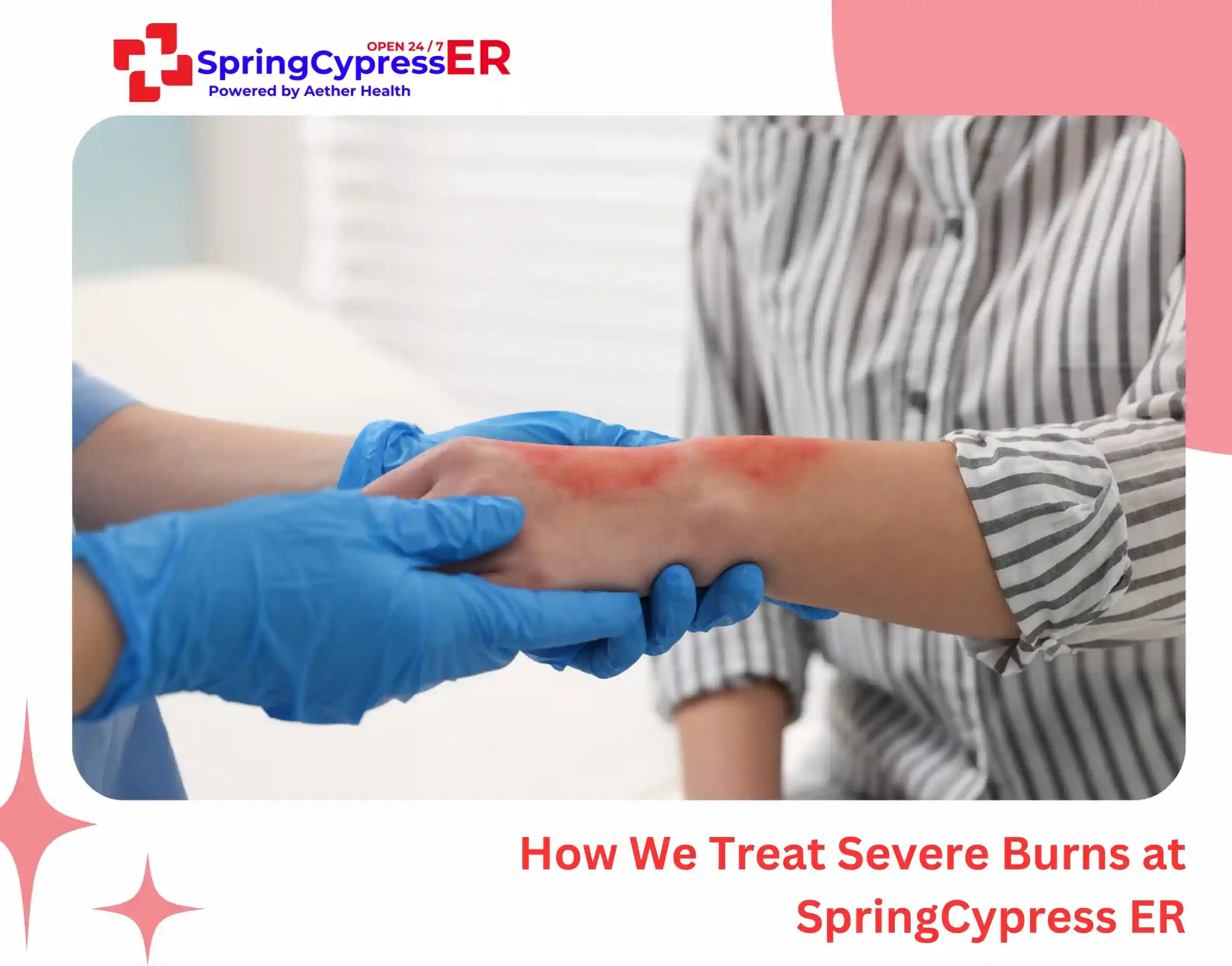
Severe burns need more than a bandage they need fluid replacement, infection control, wound care, and pain management started early. Our 24/7 freestanding ER in Spring, TX delivers all of this on site, with no transfer required for most burns.
- Burn assessment we use the “Rule of Nines” and depth assessment to grade the burn precisely and plan treatment.
- Pain management IV medications begin within minutes of arrival to break the pain cycle and reduce stress on the body.
- IV fluid resuscitation severe burns cause massive fluid loss through damaged skin. IV fluids prevent shock and protect kidney function.
- Wound cleaning and debridement we gently remove dead tissue and debris under controlled conditions to lower the risk of infection.
- Specialized burn dressings antimicrobial silver dressings, hydrogels, and non-adherent gauze that promote healing and minimize scarring.
- Tetanus protection we update your tetanus vaccine if needed; burns are a high-risk wound.
- Infection prevention topical and, when needed, IV antibiotics tailored to the burn type.
- Burn center coordination for the most severe cases, we coordinate transfer to a regional burn center with full continuity of care.
Burn Recovery: What to Expect During Healing
Burn healing happens in phases. Knowing what to expect helps you spot problems early and protect the long-term appearance and function of the skin.
Week 1 Inflammation
The burned area is red, swollen, and painful. New skin cells start forming under the wound surface. Pain is usually at its peak during this phase. Daily dressing changes and pain medication are normal. Watch for signs of infection: increasing redness, pus, fever above 100.4°F, or red streaks moving away from the wound.
Weeks 2 to 4 Regeneration
New skin begins to form. Itching is intense this is a sign of healing, but scratching can reopen the wound. The new skin is pink, fragile, and extremely sensitive to sun. Keep the area moisturized and covered. Continue follow-up wound care visits.
Weeks 4 to 12 Remodeling
Scar tissue begins forming. This is when scar management matters most: silicone sheets, compression garments, and massage (under medical guidance) can dramatically reduce the final appearance of the scar. Avoid sun exposure on the new skin for at least a year UV damage permanently darkens healing burns.
Long-term 6 months to 2 years
Scars continue to mature and soften. Range of motion may need physical therapy if the burn was over a joint. Sensation in the affected area may return slowly, or never fully. Mental health support matters too burn recovery is emotionally heavy, and counseling can be just as important as the physical treatment.
Special Cases: Chemical, Electrical, and Inhalation Burns

Not all severe burns are thermal. These three types require additional first-aid steps before reaching the ER.
Chemical Burns
Brush off any dry chemical powder first, then flush the area with cool running water for at least 20 minutes (longer for alkaline chemicals like drain cleaner). Remove contaminated clothing. Do not try to neutralize the chemical with another substance this often causes a new reaction that makes the burn worse. Bring the chemical container or label to the ER if safe to do so.
Electrical Burns
Electrical burns are deceptive the surface may look minor while internal tissue damage is severe. Turn off the power source before touching the person. Check for breathing and pulse; CPR may be needed. All electrical burns require ER evaluation, including an EKG, because the current can cause cardiac arrhythmias hours after the injury.
Inhalation Burns
If someone was burned in an enclosed space, near smoke, or shows soot around the mouth, hoarse voice, coughing, or singed nasal hairs they may have inhaled hot air or toxic smoke. Airway swelling can develop over hours and become life-threatening. Call 911 and come to the ER immediately, even if they seem to be breathing normally.
How to Prevent Severe Burns
Most severe burns we treat in Spring, TX happen in the home and are preventable with simple precautions.
- Set the water heater no higher than 120°F to prevent scalding, especially in homes with children or older adults.
- Use the back burners on the stove and turn pot handles inward.
- Never leave hot drinks, soup, or grease unattended around children.
- Install and test smoke detectors on every floor of the home.
- Store cleaning chemicals, gasoline, and lighter fluid in their original containers, out of reach.
- Use sunscreen with at least SPF 30 Texas sun causes severe burns faster than most realize.
- Keep fire extinguishers in the kitchen, garage, and near outdoor grills.
- Teach children fire safety and the “stop, drop, and roll” technique.
Frequently Asked Questions
How long should I cool a burn under running water?
Cool the burn under running water for 20 minutes. This is the single most effective first-aid step and works even if you start it up to 30 minutes after the burn happened. Cool water not cold, not ice.
Should I pop a blister from a burn?
No. Blisters protect the healing skin underneath from bacteria. If a blister breaks on its own, gently clean it with mild soap and water and cover with a non-stick dressing. Large blisters or blisters on the face, hands, or joints should be evaluated at the ER.
Can I put aloe vera on a severe burn?
Pure aloe vera gel is safe for first-degree burns once the area has cooled. It should not be applied to second-degree burns until the wound has been evaluated and cleaned by a medical professional. For severe burns, do not put anything on the wound just cover loosely and head to the ER.
How can I tell if my burn is infected?
Signs of a burn infection include increasing pain after the first 48 hours, expanding redness, swelling, pus or yellow drainage, a foul smell, fever over 100.4°F, or red streaks moving away from the wound. Any of these symptoms means come back to the ER for evaluation.
Do I need a tetanus shot after a burn?
Burns are considered tetanus-prone wounds. If your last tetanus booster was more than 5 years ago, you likely need one. We provide tetanus boosters on site at Aether Health – Spring Cypress ER as part of burn care.
Will my insurance cover an ER visit for a burn?
Aether Health – Spring Cypress ER accepts most commercial insurance plans and works directly with your insurer to avoid surprise billing. We do not currently accept Medicare, Medicaid, or Tricare. Call us before or during your visit if you have coverage questions we are happy to help.
Get Emergency Burn Care in Spring, TX Open 24/7, No Wait
Severe burns need treatment within hours, not days. At Aether Health – Spring Cypress ER, board-certified emergency physicians, on-site wound care, IV pain management, and direct burn center coordination get you stabilized fast usually within 60 minutes of walking in.
- Address: 8929 Spring Cypress Rd, Spring, TX 77379
- Phone: +1 (713) 528-8703
- Hours: Open 24 hours, every day of the year
- Insurance: Most commercial plans accepted. No surprise billing.
Call Now: +1 (713) 528-8703 speak to our team in under 30 seconds. Or walk in any time at 8929 Spring Cypress Rd, Spring, TX 77379.