
How I knew I had uterine cancer started with symptoms I almost ignored. What seemed like harmless spotting turned into a serious diagnosis months later. Many women overlook the early symptoms of uterine cancer, especially when they resemble perimenopause or hormonal changes.
Uterine cancer, also known as endometrial cancer, often begins with subtle warning signs like irregular bleeding, pelvic discomfort, or unusual discharge. One of the most important questions women ask is: is bleeding after menopause always cancer? While not always, it should never be ignored.
This personal story highlights the early signs I missed, how symptoms progressed, and why early detection can make a life-saving difference.
My story could have been different with earlier diagnosis of my uterine cancer, also called endometrial cancer. If you’re experiencing similar symptoms, please don’t rationalize them away like I did. Talk to a doctor today.
How I Knew I Had Uterine Cancer
How I knew I had uterine cancer was not through one major symptom, but a pattern of warning signs that gradually worsened. It started with irregular bleeding, followed by fatigue, pelvic discomfort, and unusual discharge.
Many women dismiss these early symptoms of uterine cancer as hormonal changes, but persistent or worsening symptoms should always be evaluated by a doctor.
It Started With Unexpected Bleeding

I was in my late 40s. I’d started spotting between periods. Some days I’d bleed for two weeks straight, then have nothing for a month. I thought it was just perimenopause. I had mood swings, hot flashes, and weird sleep patterns that seemed to confirm this.
My OB told me this could go on for years before menopause hits. So I didn’t panic. But I had a nagging feeling that maybe this wasn’t normal. Still, I brushed it off. Life was busy. And what was I gonna do—run to the ER every time I had an extra day of bleeding?
Warning Signs of Uterine Cancer I Ignored
Looking back, these were clear symptoms of uterine cancer that I ignored for too long. None of them felt urgent at the time, but together, they told a story my body was trying to communicate.
- Spotting between periods – irregular bleeding that didn’t match my usual cycle
- Longer periods – not just a day or two more, but almost two weeks some months
- Pelvic discomfort – not stabbing pain, but persistent pressure and a dull ache
- Watery discharge – more than usual, sometimes with an odd smell
- Bleeding after intercourse – something I’d never experienced before
- Fatigue – the kind where you wake up tired and go to bed exhausted
- Unexplained weight loss – without trying to diet or exercise more
None of these felt emergency-level. I told myself it was all part of “the change.”
Early Symptoms of Uterine Cancer
- Spotting between periods
- Heavy or prolonged menstrual bleeding
- Bleeding after menopause
- Pelvic pain or pressure
- Unusual watery or blood-tinged discharge
- Fatigue and weakness
- Unexplained weight loss
Worsening Symptoms: When Uterine Cancer Progresses
Months went by. It wasn’t just spotting anymore. The abnormal uterine bleeding became heavy. Like, change-my-clothes-during-the-day heavy. I started bringing extra pads to work. I noticed my anemia symptoms getting worse; feeling cold all the time and having no energy.
I told myself I needed to get checked. But between work, home chores, and just being exhausted, I kept pushing it to next week. And then next week again. What I didn’t understand was how endometrial cancer progression works – each month of delay allowed the cancer cells to grow and potentially spread beyond my uterus.
When Uterine Cancer Becomes an Emergency
One morning I woke up and felt lightheaded and weak, like I hadn’t eaten in days, even though I had. That was the first time I got scared. Maybe I was losing too much blood from what I now know was advanced uterine cancer bleeding.
One thing I knew for sure: I couldn’t ignore it anymore. The severe fatigue and dizziness were warning signs that something was seriously wrong. I finally decided to seek emergency care. Women experiencing sudden heavy vaginal bleeding with dizziness should always get immediate medical attention.
My Stage 3 Endometrial Cancer Diagnosis

When I sat down with the doctor, I talked about the months of irregular bleeding, the constant exhaustion, and the watery discharge—everything. The way he carefully listened to my concerns was such a huge relief. Here’s what my uterine cancer diagnosis process looked like:
Transvaginal Ultrasound
They did a pelvic exam and sent me for a transvaginal ultrasound. They were looking for:
- Thickness of the uterine lining (called the endometrium)
- Any unusual shapes, masses, or irregularities
- Signs of endometrial hyperplasia, which can sometimes precede cancer
Mine showed a thickened lining and a “suspicious area” they couldn’t identify clearly.
The Biopsy
To confirm, they took a sample of the lining; this is called an endometrial biopsy. It was quick (maybe 10 minutes). They sent the tissue to the lab, and I was told to expect results in about a week.
The Results
A few days later, I got the call. “We found cancer cells in the biopsy. It’s uterine adenocarcinoma, the most common type of endometrial cancer.
Further Tests
After the diagnosis, I underwent further tests to confirm my determine my cancer stage and grade:
- CT scans and MRIs to check if the cancer had spread beyond the uterus
- Bloodwork to look at overall health and check for tumor markers
- Chest X-ray to check for lung metastasis
I had been ignoring my uterine cancer symptoms for over a year. And that is what the tests showed. It had already spread outside my uterus to nearby tissues. The diagnosis was Stage 3 endometrial cancer. (But I’m still grateful that it hadn’t spread to distant organs).
My Uterine Cancer Treatment Journey
After diagnosis and initial care, I was quickly connected with a gynecologic oncologist who specialized in treating reproductive system cancers. My uterine cancer treatment plan included a total hysterectomy to remove my uterus, cervix, fallopian tubes, and ovaries. This was followed by targeted radiation and chemotherapy to address cancer cells that had spread beyond my uterus.
It wasn’t easy. There were hard days. Cancer treatment fatigue was real, along with hair loss and nausea. But slowly, I started to regain my strength. Today, I’m back to walking my dog, cooking dinner, and laughing with friends. I’m monitored regularly for any signs of endometrial cancer recurrence, but each day is a gift.
Recognizing Uterine Cancer Early: Lessons Learned
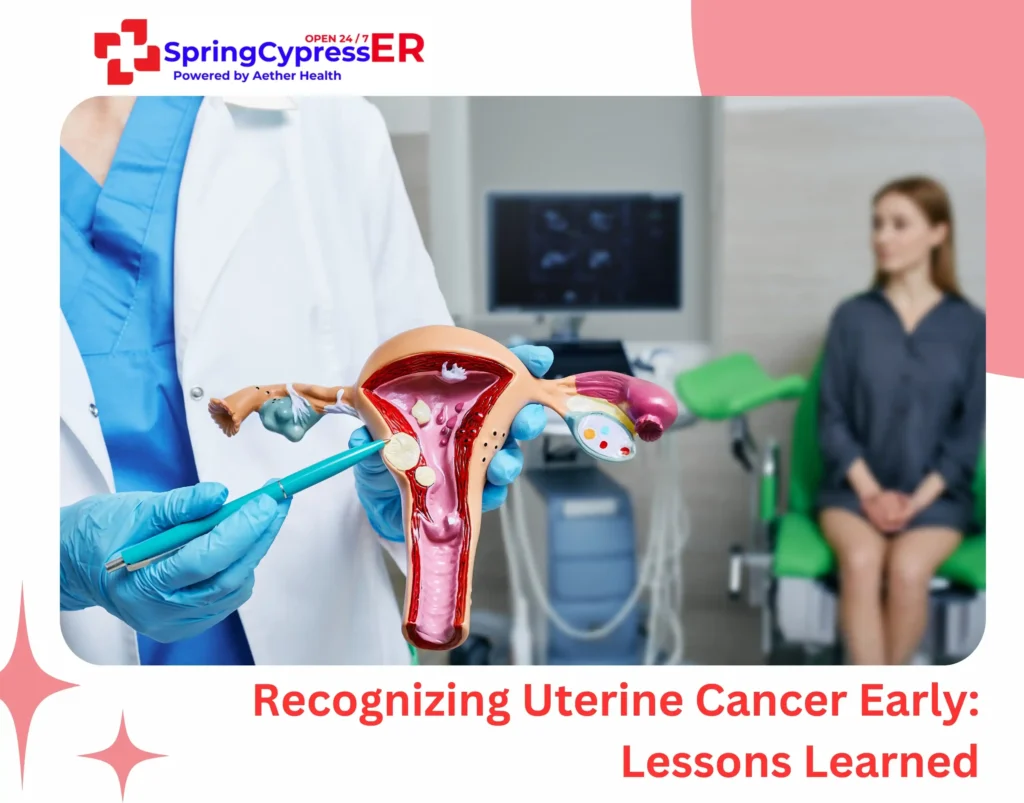
I know how easy it is to push your health to the bottom of the list; kids, spouse, work always seem more urgent. But if you don’t take care of yourself, you can’t take care of anyone else.
The reality is that uterine cancer survival rates dramatically improve with early detection. If caught in Stage 1, the five-year survival rate is over 90%. By Stage 3, like mine, those odds drop significantly.
Listen to your body when:
- Your periods change dramatically
- You experience bleeding between periods
- Post-menopausal bleeding occurs
- Pelvic pain persists
- Unusual discharge develops
Don’t wait for someone else to validate what you already feel deep down. Trust your instincts when something feels off, get the proper diagnostic tests, and find the peace of mind you deserve. The sooner endometrial cancer symptoms are evaluated, the better your outcomes can be.
Need Emergency Help? Spring Cypress ER Is Here for You
If you’re dealing with severe, sudden vaginal bleeding, extreme fatigue, or dizziness that might indicate significant blood loss, see us at the Spring Cypress ER immediately. No appointments needed!
We’re open 24/7, and we can start the diagnostic process right away with on-site imaging and lab work. While emergency care doesn’t provide complete cancer treatment, we offer crucial first steps in the diagnostic process and can connect you with the specialists you’ll need.
Let us help you feel safe, heard, and taken care of.
FAQs About Uterine Cancer
1. How I knew I had uterine cancer?
It started with irregular bleeding, fatigue, and unusual discharge that gradually worsened over time. These were early symptoms of uterine cancer that I initially ignored.
2. What are the symptoms of uterine cancer?
Common symptoms include abnormal bleeding, pelvic pain, watery discharge, fatigue, and unexplained weight loss.
3. Is bleeding after menopause always cancer?
No, but it is a major warning sign and should always be checked by a doctor immediately.
4. Can uterine cancer be detected early?
Yes. Early detection is possible when symptoms like abnormal bleeding are evaluated promptly.
5. Does uterine cancer cause pain?
Pain is usually not an early symptom but may appear as the condition progresses.